
What Your Competitors' Reviews Tell You (That They Don't Want You to Know)

Your competitors' reviews are a public database of everything their customers love and hate. Nobody password-protects them. Nobody charges for access. And almost nobody actually reads them strategically.
That's a mistake. There's operational intelligence sitting in plain sight on Google, Trustpilot, and Facebook — and it costs nothing to extract.
What You're Actually Looking For
Reading competitor reviews isn't about confirming that their service is worse than yours (though that's satisfying). It's about finding patterns you can act on. Four categories matter:
Repeated complaints they haven't fixed
If a competitor's reviews mention the same problem across six months — slow service, rude staff, parking issues, hidden fees — that's a structural issue they either can't or won't fix. That's your opportunity.
Take an illustrative example: a dental practice in Manchester notices that its main competitor's Google reviews repeatedly mention long wait times, spanning eighteen months of reviews. It makes "we run on time" a core part of its marketing and starts including actual wait time figures in its email communications. New patient bookings climb over the following quarter, for the cost of reading some reviews.
You're not looking for one-off gripes. You're looking for themes that appear at least four or five times across different reviewers. Those are systemic.
What customers praise that you don't offer
This is harder to swallow but more useful. If a competitor consistently gets praised for something — a loyalty programme, a specific menu item, free consultations, Saturday appointments — that's market demand expressed as gratitude. Pay attention to it.
Read ten 5-star reviews of your closest competitor. Write down every specific thing customers mention. Not "great service" (that's generic) but "they remembered my name," "they texted me when my car was ready," "they stayed open late to fit me in." Those specifics tell you exactly what your local market values.
Pricing and value perception
Reviews are one of the few places where customers talk openly about whether they felt a service was worth the money. Look for language like "a bit pricey but worth it," "great value," "wouldn't go back at that price," or "cheaper than expected."
This tells you where your competitor sits in the market's mental pricing map. If their customers consistently say "expensive but worth it," you know there's room either to compete on value or to position yourself as a premium alternative that offers even more. If their reviews say "cheap and cheerful," that tells you a different story about the segment they serve.
Operational details customers accidentally reveal
Reviewers inadvertently share information that businesses would never publish. Staffing levels ("there was only one person on the desk"). Wait times ("we waited 40 minutes for a table on a Tuesday"). Process details ("they called me back within two hours to confirm"). Pricing specifics ("we paid around £85 for two of us including drinks").
This is competitive intelligence that you'd normally need a mystery shopper for. Except it's free, ongoing, and covers a much larger sample size.
How to Do This Systematically
Step 1: Identify your actual competitors
Not everyone in your industry is a competitor. Your competitors are the businesses your potential customers compare you against. That's usually the three to five businesses that show up alongside you in Google's local pack, plus any that come up when you ask customers "who else did you consider?" Their Google reviews are on their Maps listing; their Trustpilot and Facebook pages are a search away.
Step 2: Read the middle, not the extremes
5-star reviews are often generic ("Loved it! Highly recommend!"). 1-star reviews are often emotional or situational ("NEVER GOING BACK. Waited five minutes and left."). The real insight lives in 2-star, 3-star, and 4-star reviews.
A 3-star review is someone who had a mixed experience and took the time to explain why. A 4-star review is someone who was mostly happy but something specific held them back from perfection. These are your goldmine.
Step 3: Build a simple tracking sheet
Create a spreadsheet with columns for: competitor name, review platform, date, star rating, key complaint or praise, and your potential action. Review it monthly. You'll start seeing patterns within eight to twelve weeks.
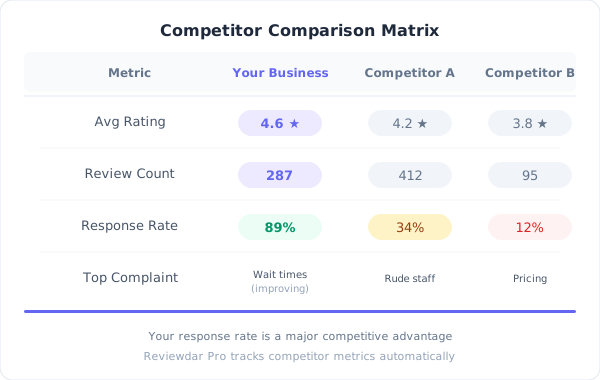
You don't need software for this (though Reviewdar's competitor tracking, available on higher plans, collects your competitors' Google reviews for you). You just need thirty minutes once a fortnight and a willingness to read what customers actually say rather than what you assume they say.
Step 4: Track changes over time
A competitor that had consistent 4.5-star ratings suddenly dropping to 4.1 over three months is a signal. They've probably lost a key staff member, changed suppliers, or cut corners somewhere. That window — while they're struggling and before they recover — is when their customers are most open to trying alternatives.
The reverse is also true. A competitor whose ratings are climbing has probably improved something. Find out what.
Turning Intelligence Into Action
Competitive review analysis only matters if you do something with it. Here are four concrete actions:
Plug their gaps in your marketing. If competitors are consistently criticised for poor communication, make responsiveness a visible part of your brand. Put "We reply within 2 hours" on your website. Then actually do it.
Train your team on their weak spots. Share anonymised competitor complaints with your staff (not as mockery, but as "here's what customers in our area care about"). If competitors get dinged for unfriendly reception staff, make sure yours are brilliant. This is specific, actionable training material that costs nothing.
Adjust your pricing with confidence. If competitor reviews consistently mention value for money positively, you know the market will bear that price point. If they consistently mention feeling overcharged, you know there's price sensitivity in your segment. Either way, you're making pricing decisions with market data instead of guesswork.
Monitor for their responses (or lack thereof). A competitor who never responds to negative reviews is telling you they either don't care or don't have the capacity. That's a service gap you can exploit simply by responding to yours. BrightLocal's Local Consumer Review Survey 2024 found 88% of consumers would use a business that replies to all its reviews.
The Ethics of This

There's nothing shady about reading public reviews. Customers write them to be read. Platforms publish them to be seen. Using that information to improve your own business is straightforward competitive practice.
What crosses the line: leaving fake negative reviews on competitors, posting fake positive reviews on your own profiles, or paying people to manipulate competitor ratings. Since 6 April 2025 those are banned practices under the Digital Markets, Competition and Consumers Act 2024, which the CMA can enforce directly with fines of up to 10% of global turnover — on top of breaching platform terms of service and basic decency. Google's policy also bars you from reviewing a competitor at all; it counts as a conflict of interest. Don't do any of it. You don't need to — the legitimate intelligence in public reviews is already more than most businesses use.
What Most Businesses Miss
The biggest missed opportunity isn't any single insight. It's the failure to do this regularly. Most business owners read competitor reviews once — maybe when they first set up their business — and then never again. Markets shift. Competitors change. Staff turn over. The review landscape from six months ago doesn't reflect today's reality.
Set a calendar reminder. Every two weeks, spend twenty minutes reading your top three competitors' recent reviews. It's the cheapest market research you'll ever do.
Reviewdar's competitor tracking, available on higher plans, follows your competitors' Google ratings and review themes automatically. See the full feature comparison.
Ready to transform your review management?
Join thousands of UK businesses using Reviewdar to manage their online reputation.