
The Real Cost of Not Responding to Reviews

45% of consumers say they're more likely to visit a business that responds to negative reviews. That comes from ReviewTrackers' consumer research, and it's one of those stats that should change behaviour immediately — but doesn't, because responding to reviews feels optional. It isn't.
Not responding to reviews costs you money. Here's how much, and why.
The Numbers: What Silence Actually Costs
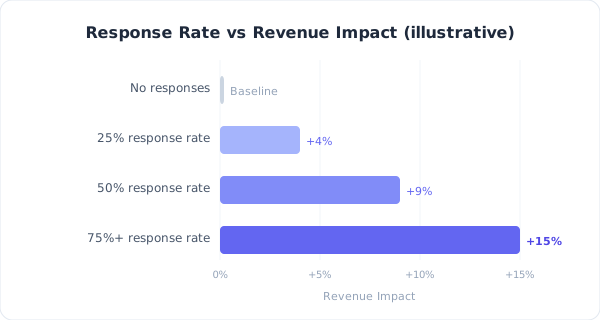
Lost revenue from unconverted browsers
A Harvard Business School study on the hospitality industry found that a one-star increase in Yelp rating leads to a 5-9% increase in revenue. That study focused on restaurants, but the Spiegel Research Center found the same shape across sectors: purchase likelihood climbs with rating and peaks between 4.2 and 4.5 stars.
Now consider what happens when potential customers see unanswered negative reviews. They don't just see the complaint — they see that you didn't care enough to respond. 53% of customers expect businesses to reply to negative reviews within a week, according to ReviewTrackers. When that doesn't happen, it signals one of two things: either you don't monitor your reviews (careless) or you saw it and chose to ignore it (dismissive). Neither interpretation wins you the sale.
The compound effect on your rating
Responding to reviews — positive and negative — correlates with better results over time. Businesses that reply to at least 25% of their reviews earned 35% more revenue than the average business, according to Womply's analysis of more than 200,000 US small businesses. And responding lifts the rating itself: Proserpio and Zervas found that hotels which began replying on Tripadvisor gained about 0.12 stars and 12% more reviews.
A tenth of a star doesn't sound like much. But on platforms that round to the nearest half star, it can be the difference between displaying 4.0 and 4.5 — and between a customer choosing you over the competitor listed next to you.
Customer retention after a negative experience
Customers who complain and receive a satisfactory response are actually more loyal than customers who never had a problem. It's called the service recovery paradox, documented in research since the 1990s. A customer who leaves a 2-star review and gets a thoughtful response has a real chance of updating the review or coming back. Silence gets you a near-zero chance of either.
Response Rates by Industry: Where the UK Stands
Not all industries are equally bad at this, but most are bad enough.
There's no reliable UK-wide benchmark, but the pattern is consistent wherever anyone has measured it. Most small businesses reply to few of their reviews or none at all. Hospitality tends to be the most engaged; professional services — accountants, solicitors, financial advisers — and tradespeople the least. Scroll through the Google listings for plumbers in any UK town and count the replies. You won't need both hands.
For context, the businesses that do best reply to nearly everything. The gap between average and best practice is enormous, which means the opportunity for differentiation is equally large.
If you're a tradesperson in Birmingham responding to every review, you're already ahead of nearly everyone in your category. That takes a few minutes a day and costs nothing.
What "Responding" Actually Means
A bad response is sometimes worse than no response. We've all seen them:
"Thank you for your feedback, we value all our customers and strive to provide the best service. Please contact us directly to discuss." — This says nothing. It's a template, and everyone can tell.
"We're sorry you feel that way." — This is a non-apology. It puts the problem on the customer's feelings rather than on your service. People hate it.
"This review is unfair and doesn't reflect what happened." — Going on the defensive in public is never a good look, even when you're right.
Here's what works:
For negative reviews
Acknowledge the specific issue. Apologise without qualification. State what you're doing about it. Offer to continue the conversation privately.
"Hi Sarah, I'm sorry about the wait on Saturday — we were short-staffed and it wasn't good enough. We've since changed our weekend rota to avoid this happening again. I'd like to make it right — could you email me at [address] so we can sort something out?"
This takes 60 seconds to write. It tells Sarah you care. It tells every future customer reading this review that you take problems seriously and fix them. That public accountability is worth more than any marketing campaign.
For positive reviews
Don't just say "Thanks!" Say something specific that shows you actually read the review and remember the interaction.
"Thanks Mark — glad you enjoyed the Sunday roast. The beef comes from a farm in Shropshire we've worked with for years, so it's nice to know people notice the difference. See you next time."
This turns a review response into a micro-advertisement. Anyone reading it now knows about your locally sourced beef. You've added information that helps future customers choose you.
For mid-range reviews (3 stars)
These are the most valuable reviews to respond to because the customer is on the fence. They liked some things but not others. Your response can tip them toward a return visit.
"Hi Alex, thanks for the honest feedback. Glad the food hit the mark — sorry the noise level wasn't great. We've looked into acoustic panels and they're going in next month. Would love to have you back once they're in to see if it makes a difference."
You've turned a lukewarm review into a story about a business that listens and improves.
The Time Argument (And Why It Doesn't Hold Up)

The most common reason businesses give for not responding to reviews is time. And yes, if you have sixty reviews across four platforms and you're trying to manage everything manually, it does take a while.
But the maths doesn't support it. The average review response takes 90 seconds. Most small businesses get somewhere between a handful and a dozen reviews per week across all platforms. That's 6-18 minutes weekly — less time than a single Instagram post. And review responses reach people who are actively deciding whether to spend money with you, not just your existing followers.
The Google Algorithm Factor
Google says responding to reviews can help: its own guidance on improving local ranking lists replying to reviews alongside keeping your profile complete and accurate. Response rate on its own isn't a confirmed ranking factor — review volume and rating carry more weight, and Whitespark's Local Search Ranking Factors puts reviews third among local pack factors, behind the Business Profile itself and on-page signals. But replying is cheap, and Google tells you to do it.
Building the Habit
The businesses that respond to every review don't rely on willpower. They have a system.
Set a daily time — many owners do it first thing with their morning coffee. Check all platforms, or use a tool like Reviewdar that aggregates them into one inbox and drafts a reply you can edit before posting. Respond to everything from the last 24 hours. Move on.
Each platform has its own reply box: Google through your Business Profile, Facebook under the Recommendation itself, Trustpilot and Tripadvisor from their business dashboards. None takes more than a minute to find once you've done it twice.
That daily habit, maintained for three months, will visibly improve your online reputation. Your average rating will trend upward. Your local search visibility may improve with it. And you'll develop an instinct for turning complaints into opportunities that no amount of marketing spend can replicate.
Reviewdar pulls all your reviews into a single inbox and helps you respond faster with AI-drafted replies you edit before posting. Start your free trial and see the difference response rates make.
Ready to transform your review management?
Join thousands of UK businesses using Reviewdar to manage their online reputation.