
How to Respond to Negative Reviews Without Losing Your Mind (or Your Customers)

You've just seen a one-star review. Your stomach drops. Your first instinct is to either fire back or pretend it doesn't exist.
Both are wrong.
Negative reviews are uncomfortable, but they're also one of the most powerful tools you have — if you handle them well. Here's a framework that works for UK small businesses without requiring a PR team or a therapist.
Why Your Response Matters More Than the Review
Here's something most business owners don't realise: the review itself isn't what most people read. Your response is.
When a potential customer sees a negative review, they're not thinking "this business must be terrible." They're thinking "how did they handle it?" Your response is an audition in front of every future customer who reads that page.
A thoughtful, professional response to a one-star review can actually increase trust more than another generic five-star review. It proves you're real, you care, and you take responsibility.
The HEAR Framework
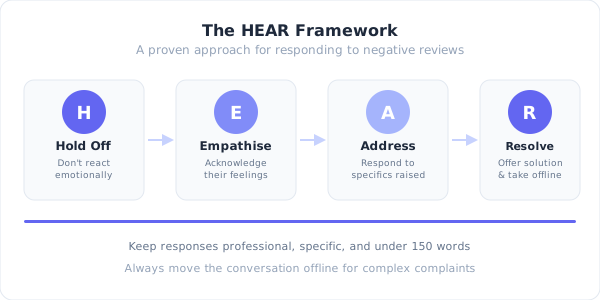
When you get a negative review, use HEAR:
H — Hold off
Don't respond immediately. Give yourself at least an hour. Your first draft will almost certainly be defensive, and defensive responses always read badly. Sleep on it if you can.
The exception: if the review alleges something serious (health and safety, discrimination, fraud), respond promptly but stick to facts. "We take this very seriously and would like to discuss this directly" is fine as an immediate holding response.
E — Empathise first
Start your response by acknowledging the customer's experience. Not "we're sorry you feel that way" (which is dismissive), but a genuine recognition that their experience wasn't what you'd want it to be.
Good: "Thank you for taking the time to share this. It's clear your visit didn't meet the standard we aim for, and that's not acceptable to us."
Bad: "We're sorry you had a negative experience, but we serve hundreds of happy customers every week."
The "but" in that second example undoes everything before it. Customers can smell defensiveness from a mile away.
A — Address specifically
Reference the specific issue they raised. This shows you actually read their review, not just copy-pasted a template.
If they complained about waiting times: "You're right that a 45-minute wait for a table isn't good enough, especially on a weeknight."
If they complained about staff attitude: "The experience you've described with our front-of-house team isn't reflective of how we train or expect our team to operate."
Be specific without being defensive.
R — Resolve and redirect
Offer a clear next step and move the conversation offline.
Good: "I'd like to understand more about what happened and make this right. Could you email me directly at [name]@[business].co.uk? I'm the owner and I'll handle this personally."
Bad: "Please call our customer service team on 0800..."
The personal touch matters enormously. Giving a name and a direct email signals that this is being taken seriously by someone who can actually do something about it.
What Never to Do
Don't argue with facts
Even if the customer is wrong about specific details, publicly correcting them makes you look petty. Address factual errors gently and briefly, then move on.
Don't copy-paste the same response
If someone scrolls through your reviews and sees the same "We're sorry to hear about your experience. Please contact us at..." on every negative review, they'll conclude that you don't actually care — you just have a crisis-management template.
Each response should reference something specific from that review.
Don't offer compensation publicly
"Come back and your next meal is on us" sounds generous, but it also incentivises people to leave negative reviews for free stuff. Handle compensation privately, and never make it conditional on the review being changed or removed — Google's policies prohibit that, and since the Digital Markets, Competition and Consumers Act 2024 came into force the CMA treats undisclosed incentives around reviews as a banned practice.
Don't ignore it
This is the most common mistake. An unanswered negative review is worse than a badly answered one, because it suggests you either don't know or don't care. Both are damaging.
The one exception is a review that breaks the platform's rules — fake, about a different business, or abusive. Flag it through the platform's reporting tool, and still post a short, calm reply while you wait, because removal takes time and is not guaranteed.
Don't get the last word
If a customer responds to your response and it's still negative, resist the urge to reply again. You've said your piece publicly. Take it offline. A back-and-forth argument on Google Reviews is nobody's idea of a good brand impression.
Templates That Don't Sound Like Templates
Here are starting points you can adapt. The key word is adapt — don't use them verbatim.
For a service complaint
Thank you for sharing this, [Name]. A [specific time] wait for [specific thing] isn't what we'd want for any customer, and I understand the frustration. We've looked into what happened on [date] and have [specific action — e.g., "adjusted our booking system" / "spoken with the team"]. I'd really like the chance to make this right — would you be open to emailing me at [email]? — [Your name], [Role]
For a product quality complaint
Hi [Name], thank you for letting us know. The [specific issue] you've described shouldn't have happened, and I'm sorry it did. We've [specific action — e.g., "pulled that batch for testing" / "reviewed our QC process"]. I'd like to arrange a replacement and hear more about your experience — could you drop me a line at [email]? — [Your name]
For a vague or unfair review
Hi [Name], I'm sorry your experience wasn't up to standard. We'd love the opportunity to understand what went wrong — sometimes there's more to the story than a review can capture. If you're open to it, please reach out to me at [email] and I'll do my best to sort this out. — [Your name]
The Operational Payoff
Beyond reputation management, negative reviews are genuinely useful operational data — possibly the most honest feedback your business will ever receive.
Track the themes. If three unrelated customers mention slow service in the same month, that's not bad luck — that's a process problem. If complaints cluster around a specific location or time of day, you've just identified exactly where to focus.
The businesses that improve fastest aren't the ones that avoid negative reviews. They're the ones that systematically learn from them.
How Fast Should You Respond?
For negative reviews:
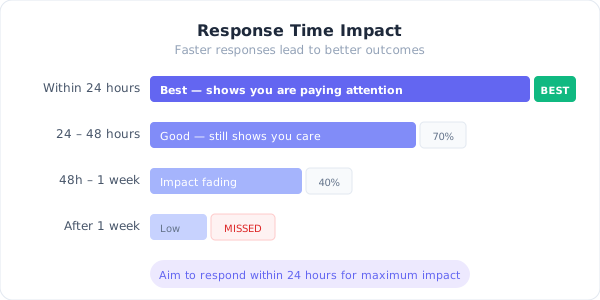
- Within 24 hours is the goal
- Within 48 hours is acceptable
- After a week — you've missed the window
The customer who left the review is watching for your response. So is everyone else.
For positive reviews, you have more breathing room — a few days is fine. But negative reviews have a short half-life for making things right.
The Bottom Line
A negative review is a conversation, not a verdict. Handle it well and you turn a bad moment into proof that you're a business worth trusting. Handle it badly — or not at all — and you confirm the reviewer's worst impression.
Your response isn't for the person who left the review. It's for the hundred people who'll read it next.
Reviewdar drafts a reply to each review for you to edit before posting — a specific starting point rather than a template, available on paid plans. See how it works →
Ready to transform your review management?
Join thousands of UK businesses using Reviewdar to manage their online reputation.