
Introducing Reviewdar: A Practical Reputation Platform for UK Small Businesses

Most UK small business owners check their Google reviews. Some check Facebook. Almost nobody checks all five platforms where customers actually leave feedback. That gap between where you look and where people talk about you is where reputation problems grow.
Reviewdar exists to close that gap.
The problem is scattered attention
A plumber in Birmingham gets a glowing review on Trustpilot. A café owner in Bristol has a one-star complaint sitting on Tripadvisor from three weeks ago. A boutique in Manchester doesn't realise their Facebook page has six unanswered reviews from recent customers.
None of these business owners are lazy. They're busy. They opened their business to do the work, not to spend forty minutes each morning cycling through review platforms.
The maths gets worse as you grow. A single-location business with profiles on Google, Facebook, Trustpilot, Yelp, and Tripadvisor has five dashboards to monitor. Add a second location and it doubles. By three locations, you're looking at fifteen separate places where customers might be saying something that needs your attention right now.
That's the operational reality Reviewdar addresses.
What Reviewdar actually does
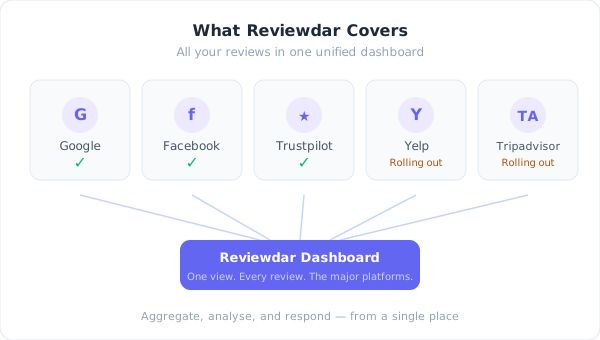
Reviewdar pulls reviews from Google, Facebook and Trustpilot into a single dashboard. Read-only Tripadvisor and Yelp imports are rolling out on higher plans. Every review, every rating, every piece of customer feedback across all your locations — one screen.
Here's what that means in practice:
Unified inbox. New reviews from any platform appear in one feed. You see them when they arrive, not when you remember to check that particular site. Filter by platform, star rating, location, or date range.
AI-generated response suggestions. For each review, Reviewdar generates a draft response that matches your business's tone. You can edit it, approve it, or ignore it. The AI doesn't post anything without your say-so. It's a starting point, not an autopilot.
Sentiment analysis. Beyond star ratings, Reviewdar analyses what customers actually say. A four-star review that mentions slow service tells you something different from a four-star review praising your food. The platform pulls out recurring themes — service speed, cleanliness, value for money, staff friendliness — so you can spot patterns across hundreds of reviews without reading every one.
Competitor tracking. On higher plans, you can monitor competitors' Google reviews alongside your own. Not to obsess over them, but to understand where you stand. If every competitor in your area gets complaints about parking, that tells you something about customer expectations. If one competitor suddenly improves their ratings, you'll want to know what changed.
Multi-location management. If you run more than one location, each gets its own review stream within the same account. Compare performance across sites. Identify which location needs attention and which is running smoothly.
Who it's built for
Reviewdar is built for UK small businesses. That's not a marketing line — it shapes real product decisions.
We focus on the platforms UK consumers actually use. Trustpilot is headquartered in Copenhagen and has massive UK adoption, particularly for service businesses and e-commerce. Tripadvisor matters here for hospitality in a way that varies by region. Google dominates everywhere but isn't the whole picture. These platform priorities are different from what a US-focused tool would choose.
Pricing is in pounds. Support understands UK business contexts. The sentiment analysis handles British English, including the kind where "not bad, actually" is high praise.
The typical Reviewdar user runs a restaurant, trades business, salon, hotel, dental practice, or retail shop. They have between one and ten locations. They care about their reputation but don't have a marketing team to manage it.
How the pricing works
Straightforward, and in pounds.
You can start free with Google reviews only and no AI-drafted replies — useful if you just want a cleaner way to monitor your Google reviews and see how sentiment is trending.
Paid plans add Facebook and Trustpilot, AI-drafted replies, daily sentiment analysis, review-request emails and QR codes, and room for more locations and team members. Higher plans add competitor tracking and advanced reporting, and read-only Tripadvisor and Yelp imports are rolling out on them. Paid plans start with a free trial.
No setup fees, cancel whenever. Current prices and limits are on the pricing page.
Why not just use Google directly?
Google Business Profile is free and fine for what it does. If you only have one location and only care about Google reviews, honestly, you might not need Reviewdar.
But Google's own tools don't show you Facebook reviews. They don't tell you what's happening on Trustpilot. They don't analyse sentiment trends over time. They don't generate response drafts. And they definitely don't let you compare your review performance against the competitor down the road.
The moment you need visibility across platforms — or the moment you're spending more than ten minutes a day on review management — a dedicated tool starts paying for itself.
What Reviewdar doesn't do
Worth being upfront about the boundaries.
Reviewdar doesn't generate fake reviews. It doesn't offer review gating (filtering out negative reviews before they go public). It doesn't post responses automatically without your approval. These are deliberate choices, not missing features. Review manipulation is short-sighted and violates most platform terms of service. It's also increasingly easy to detect.
Reviewdar also doesn't replace the need to actually run a good business. No amount of review management fixes a genuinely bad customer experience. What it does is make sure that when customers share their honest opinions — good or bad — you hear about it quickly and can respond thoughtfully.
The UK review landscape is shifting
BrightLocal's Local Consumer Review Survey 2024 found that 81% of consumers use Google to read reviews of local businesses. Google is where the habit starts, but it is not where it ends.
What's changing is where people look. Not long ago, Google was the only game in town for local search reviews. Now consumers cross-reference: the same survey found 36% use two review sites when choosing a local business and 41% use three or more. They'll check Google, then look at Trustpilot, then see what Facebook says. A business with strong Google reviews but a poor Trustpilot score sends a confusing signal — and confused consumers pick someone else.
Managing your reputation across platforms isn't optional anymore. It's just that doing it manually doesn't scale.
That's the problem. Reviewdar is the fix.
See which plan fits your business at reviewdar.com/pricing, or explore the full feature set at reviewdar.com/features.
Ready to transform your review management?
Join thousands of UK businesses using Reviewdar to manage their online reputation.