
Managing Reviews Across Multiple Locations: A Practical Guide

One location is manageable. You check Google, maybe Facebook, reply to a few reviews over coffee. It takes fifteen minutes.
Then you open a second location. And suddenly it's not fifteen minutes — it's thirty, across twice as many platforms, with twice as many things to miss. By the time you have three or four locations, review management has become a genuine operational problem that nobody formally owns.
Here's how to handle it without losing your mind.
Why Multi-Location Review Management Is Different
It's not just "more reviews." The challenge fundamentally changes:
Inconsistency becomes visible
When you have one location, your reputation is your reputation. With multiple locations, customers and competitors can see the difference. A 4.7 in Birmingham and a 3.9 in Leeds tells a story — and anyone comparing the two profiles will read it.
Nobody owns it
In a single-location business, the owner usually manages reviews. In a multi-location setup, it often falls into a gap between local managers (who are busy running the location) and head office (who don't have the local context to respond well). The result: reviews go unanswered, patterns go unnoticed.
Comparison becomes the job
The value of multi-location review data isn't just responding to individual reviews — it's understanding why Location A consistently outperforms Location B. That comparative insight is where real operational improvement comes from. But you can only see it if you're looking at all your locations together.
A Framework That Works
1. Centralise visibility, distribute responses
The most common mistake is trying to fully centralise review management. Head office writes every response, using templates, and it sounds... like head office wrote every response using templates.
Instead:
- Centralise monitoring — all locations, all platforms, one view
- Distribute responding — local managers respond, because they know the context
- Centralise standards — tone of voice guidelines, response time expectations, escalation rules
This gives you the best of both worlds: complete visibility with authentic, locally-informed responses.
2. Set response time standards
Define clear expectations:
- Negative reviews: Response within 24 hours
- Neutral reviews: Response within 48 hours
- Positive reviews: Response within 72 hours
Track compliance by location. Response time is one of the simplest metrics to measure and one of the most impactful to improve. A location that consistently responds within 12 hours will build a measurably stronger online reputation than one that takes a week.
3. Create a location scorecard
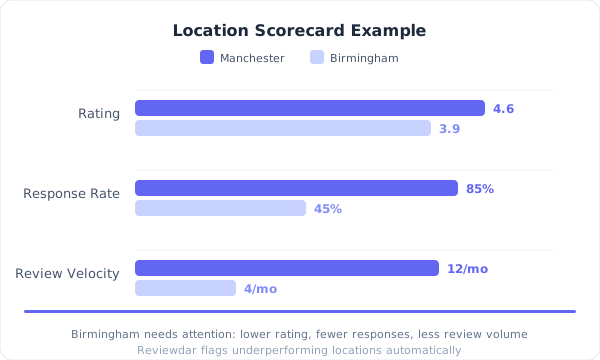
Track these metrics per location, per month:
| Metric | What it tells you |
|---|---|
| Average rating | Overall satisfaction |
| Review count | Customer engagement with feedback |
| Review velocity | Are you getting enough new reviews? |
| Response rate | Are reviews being answered? |
| Average response time | How quickly? |
| Sentiment themes | What are people actually saying? |
The scorecard isn't about punishment. It's about making the invisible visible. When a location manager can see that their response rate is 60% while the average across the group is 85%, they'll fix it without being told.
4. Identify cross-location patterns
This is where multi-location review management gets genuinely strategic.
If three locations independently start receiving complaints about wait times in the same month, that's not a local problem — it's a systemic one. Maybe a supply chain issue, a staffing model change, or a process that scaled badly.
Conversely, if one location consistently gets praised for something the others don't, that's a best practice you should be spreading across the group.
Cross-location pattern recognition is the single biggest advantage of managing reviews centrally. Individual locations can't see it. Only the person (or tool) looking at everything together can.
5. Standardise review generation
If each location has its own approach to asking for reviews — or worse, no approach at all — you'll get wildly inconsistent review volumes. The location with an enthusiastic manager who asks every customer will have 200 reviews. The one without will have 30.
Standardise:
- When to ask (at point of service completion)
- How to ask (direct link, QR code, email follow-up)
- Who asks (front-line staff, with a simple script)
Then track review velocity per location as a KPI. It's one of the easiest operational metrics to influence.
Common Pitfalls
Template responses across locations
Nothing screams "we don't really care" like identical responses on reviews for different locations. Even if you use a framework (and you should), the actual words need to be location-specific and review-specific.
Ignoring underperforming locations
It's human nature to focus on your best performers. But the location with a 3.8 rating is the one that needs the most attention — and the one where improvement will have the biggest impact on overall group reputation.
Comparing locations unfairly
A high-street restaurant in a busy city centre will naturally get more reviews (and more varied ratings) than a village café. Compare like with like. Velocity relative to footfall matters more than absolute numbers.
No escalation process
What happens when a location gets a one-star review alleging something serious? If the answer is "the local manager deals with it... probably," you need an escalation process. Define what gets escalated, to whom, and how fast.
The Technology Question
At 1-2 locations, you can manage reviews manually. It's not efficient, but it's possible.
At 3+ locations across multiple platforms, manual management breaks down. You miss reviews, you can't spot patterns, and you definitely can't track response times or sentiment themes at scale.
This is where centralised review management tools earn their keep — not as a luxury, but as an operational necessity. The key things to look for:
- All locations, all platforms, one dashboard — so you actually see everything
- Per-location analytics — so you can compare and benchmark
- Sentiment analysis — so you can track themes without reading every review manually
- Response tracking — so you know what's been answered and what hasn't
- Team workflows — so the right people respond to the right reviews
Reviewdar is built around this: a per-location view of your Google, Facebook and Trustpilot reviews (read-only Tripadvisor and Yelp imports are rolling out on higher plans), sentiment themes across the whole group, and a CSV summary report to start the monthly scorecard from. How many locations and team seats you can add depends on your plan — see the pricing page.
Getting Started

If you're currently managing multi-location reviews ad hoc, here's a practical starting sequence:
- Audit your current state — What's each location's rating, review count, and response rate right now?
- Claim all profiles — Make sure every location's Google Business Profile (and Facebook, Trustpilot, etc.) is claimed and accurate. Google lets you manage all your locations under one business group, which makes the next step far easier
- Set standards — Response time targets, escalation rules, tone guidelines
- Centralise monitoring — Get everything into one view
- Distribute responsibility — Assign clear ownership for responding at each location
- Track and review monthly — Use the scorecard to drive improvement
You don't need to do all of this in a week. But doing it in this order means each step builds on the last.
The Bottom Line
Multi-location review management isn't just "single-location management times N." It's a different discipline — one that combines operational oversight, comparative analytics, and distributed team workflows.
The businesses that do it well gain a genuine edge: faster improvement cycles, more consistent customer experiences, and stronger online visibility across every location.
Reviewdar is built for multi-location businesses. Compare locations, see what's still waiting for a reply, spot patterns across your whole operation — all from one dashboard. See plans →
Ready to transform your review management?
Join thousands of UK businesses using Reviewdar to manage their online reputation.