
Multi-Platform Review Management: Why Your Business Needs to Look Beyond Google
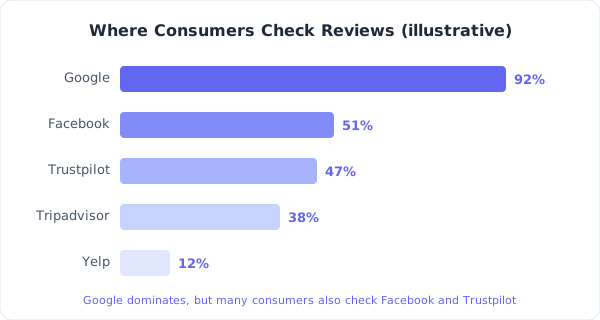
Google is where most reviews get read: BrightLocal's Local Consumer Review Survey 2024 found that 81% of consumers use it to read reviews of local businesses. That makes Google the obvious starting point for any business thinking about its online reputation. But starting point is the key phrase. Stopping there leaves real blind spots.
Different customers use different platforms. And each platform serves a different function in the buying decision. Treating Google as the only place that matters is like only checking one aisle of a supermarket and assuming you've seen everything on offer.
Each platform attracts a different customer mindset
Google reviews happen at the search stage. Someone types "plumber Nottingham" and scans the local pack results. They're comparing options, often in a hurry. Google reviews help them narrow a list.
Facebook works differently. People find your business through friends' recommendations and local community groups. Facebook reviews (now "Recommendations") are social proof within a social context. When someone posts "Can anyone recommend a good roofer?" in a local group, responses carry weight because they come from people with names, faces, and mutual friends.
For UK local businesses — trades, hospitality, personal services — Facebook groups are a major discovery channel that drives more business than many owners realise.
Trustpilot occupies a space in the UK market with no real equivalent elsewhere. It's the default for service businesses, e-commerce, and anything transacted online or by phone. UK consumers treat it like a credibility check — an insurance broker or estate agent without a Trustpilot presence looks incomplete.
The UK is one of Trustpilot's largest markets. If you sell services in the UK, Trustpilot reviews influence purchase decisions whether you've claimed your profile or not.
Tripadvisor dominates hospitality. Hotels, restaurants, pubs, and tourist attractions live and die by Tripadvisor rankings in their area. Tripadvisor says its popularity ranking weighs the quality, recency and quantity of reviews, which means a hotel with a steady flow of good recent reviews can outrank one with a higher average score but fewer recent reviews. For UK hospitality businesses, especially those in tourist-heavy areas, Tripadvisor isn't optional — it's infrastructure.
Yelp has a smaller UK presence than in the US, but it matters for restaurants and food businesses in major cities. London, Manchester, Edinburgh, and Birmingham all have active Yelp communities. Yelp also tends to attract more detailed, opinionated reviewers. The reviews are longer and more specific, which means both the praise and the criticism carry more detail.
Consumers cross-reference platforms
Here's the behaviour pattern that catches businesses off guard: consumers don't stick to one platform.
A typical journey looks like this. Someone searches Google, finds your business in the local pack, and sees your 4.3-star rating. Good start. Then they click through to your website, notice a Trustpilot widget showing 3.1 stars, and hesitate. They check Facebook, find three unanswered negative recommendations from six months ago. They book with your competitor instead.
BrightLocal's Local Consumer Review Survey 2024 found that 36% of consumers use two review sites when evaluating a local business, and a further 41% use three or more. The fragmented nature of review platforms means your reputation isn't defined by any single source — it's the composite picture across all of them.
A strong Google presence paired with an abandoned Trustpilot profile sends a confusing signal. It suggests either that you don't know about the other platform (unlikely) or that you're ignoring it (worse).
The operational problem is real
Monitoring five platforms manually is tedious and unreliable.
The daily routine looks something like this: log into Google Business Profile, check for new reviews, respond. Switch to Facebook, check notifications, respond. Open Trustpilot, check the dashboard, respond. Repeat for Tripadvisor and Yelp.
That's five logins, five different interfaces, five different notification systems, five different response workflows. For a single location, it takes 20-30 minutes daily if you're thorough. Most people aren't thorough. They check Google, maybe glance at Facebook, and skip the rest.
The problem compounds with multiple locations. Two locations across five platforms means ten separate feeds. Three locations means fifteen. The maths defeats good intentions quickly.
This is where reviews get missed. Not because the owner doesn't care, but because the operational burden makes consistent monitoring impractical. And a missed negative review — one that sits unanswered for weeks — does more reputational damage than most positive reviews can offset.
Platform-specific response strategies

Each platform has its own conventions, and getting this wrong stands out.
Google responses are public and indexed by search engines. They're partly for the reviewer and partly for everyone reading later. For negative reviews, acknowledge the issue and offer to resolve it offline.
Facebook lets you comment publicly and message directly. For negative feedback, do both — a public acknowledgment paired with a private message. Friends and neighbours see how you handle complaints here.
Trustpilot users expect a more considered reply. The platform also lets businesses invite customers to review, which is a legitimate way to build volume — as long as you invite every customer and offer nothing for it. Since 6 April 2025 the Digital Markets, Competition and Consumers Act 2024 has made fake reviews and undisclosed incentivised reviews banned practices, enforced directly by the CMA.
Tripadvisor shows management responses prominently and encourages owners to reply; response rate is not a published ranking factor, but readers judge you on it. Hospitality businesses should respond to every review. A management response thanking a positive reviewer takes 30 seconds.
Yelp filters reviews it considers unreliable with limited transparency. Respond to show engagement, but don't try to game the filter — it backfires.
What a unified approach looks like
Managing multiple platforms well requires a system, not just effort. The system has three parts.
Monitoring. All reviews from all platforms arrive in one place. The mechanism matters less than the consistency. If a review can go unnoticed for a week, your system has a gap.
Response. Set a target: within 24 hours, faster for negative reviews. Response templates as starting points — not copy-paste scripts — speed this up without sounding robotic.
Analysis. Individual reviews are anecdotes. Aggregated data is intelligence. Maybe your Google reviews are strong but Trustpilot is sliding. Maybe one location gets praise for staff while another gets wait time complaints. These patterns only emerge when you see everything together.
The cost of ignoring platforms
Ignoring a review platform doesn't make it go away. Customers still leave reviews there. Those reviews still appear in search results.
An unmonitored Trustpilot profile accumulates whatever reviews come in organically — and dissatisfied customers disproportionately seek out review platforms. Without management, Trustpilot profiles skew negative over time. An abandoned Facebook page signals a business that's checked out.
The cost is usually invisible: customers who looked at your multi-platform presence, felt uncertain, and chose someone else. You never see those lost opportunities in your data.
Making it manageable
The answer isn't to work harder. It's to reduce the operational overhead of multi-platform management to something sustainable.
Claim and complete your profiles on every relevant platform — Google Business Profile, your Facebook Page, Trustpilot's business sign-up, Tripadvisor's Management Centre and Yelp for Business all have a free claim-and-verify flow. Make sure business information is consistent across all of them — name, address, phone number, opening hours. Inconsistencies between platforms confuse both customers and search algorithms.
Then get your monitoring into a single workflow. The specific tool matters less than having one. Manual checking across five platforms three times a day is a system that will break the first time you're busy with an actual customer emergency.
Reviewdar pulls Google, Facebook and Trustpilot reviews into one inbox, with read-only Tripadvisor and Yelp imports rolling out on higher plans, and gives multi-location businesses one dashboard across all of them. See the full feature breakdown at reviewdar.com/features or compare plans at reviewdar.com/pricing.
Ready to transform your review management?
Join thousands of UK businesses using Reviewdar to manage their online reputation.