
How Online Reviews Impact Small UK Business Revenue

A one-star increase on Yelp leads to a 5–9% increase in revenue. That number comes from Michael Luca's research at Harvard Business School, and it's been cited so often it's practically wallpaper. But it deserves more than a casual mention, because the mechanism behind it explains why reviews matter far more than most UK business owners realise.
The effect isn't just "good reviews = more customers." It's about visibility, trust, and the specific moments where a potential customer decides yes or no.
Star ratings change click-through rates
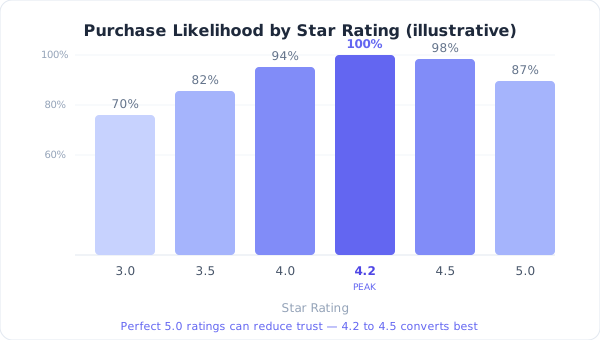
BrightLocal's Local Consumer Review Survey 2024 found that 81% of consumers use Google to read reviews of local businesses, and Northwestern University's Spiegel Research Center found that purchase likelihood peaks between 4.2 and 4.5 stars. Below four stars you are losing people who never tell you why. The jump from three to four stars is where most of the commercial action happens.
For UK businesses appearing in Google's local pack — the map results that show up for searches like "electrician near me" or "best curry in Leeds" — star ratings are the first thing people see. Before your business name, before your address, before anything else. Google displays your average rating right there in the search results.
A business sitting at 3.8 stars next to a competitor at 4.4 stars loses clicks before the customer even visits the website. That click never shows up in your analytics. You don't know you lost it.
Review volume affects local search ranking
Google's local search algorithm uses three main factors: relevance, distance, and prominence. Prominence includes, among other signals, your review count and average rating.
The Whitespark Local Search Ranking Factors 2023 survey put review signals (quantity, velocity, diversity, and rating) as the third-largest factor for local pack rankings — behind only the Google Business Profile itself and on-page signals.
Two identical businesses equidistant from a searcher, offering the same service, rank differently based partly on reviews. More recent, higher-rated reviews mean higher placement, more visibility, more clicks, more revenue. Google's own guidance on local ranking says review count and score factor into it.
The revenue impact in UK-specific terms
Womply's 2019 analysis of more than 200,000 US small businesses found that businesses replying to at least 25% of their reviews earned 35% more revenue than those that didn't respond at all.
UK-specific data is harder to come by at that scale, but the dynamics are the same. The UK's Competition and Markets Authority estimated in 2015 that online reviews influence £23 billion of UK consumer spending annually. Adjusted for inflation and the growth of online review usage since then, the current figure is almost certainly higher.
UK consumer surveys land in the same place: most people check reviews before trying a new local business, and Trustpilot's strength in the UK market means that for many service businesses the check happens there as well as on Google.
These aren't abstract numbers. For a restaurant doing £400,000 annual revenue, even a conservative 5% impact from improved review performance means £20,000. For a trades business billing £150,000, it's £7,500. That's the cost of a van, a piece of equipment, or a part-time hire.
Response rate matters as much as rating

Here's something that surprises many business owners: responding to reviews — especially negative ones — has a measurable effect on revenue independent of your star rating.
Research by Proserpio and Zervas (Marketing Science, 2017) found that hotels that began responding to Tripadvisor reviews saw a 12% increase in review volume and a rating increase of about 0.12 stars. Not because operations changed — because potential customers perceived a responsive business as more trustworthy.
The mechanism makes sense when you think about it from the customer's perspective. You're looking at two restaurants. Both have 4.2 stars. One has the owner responding to every review — thanking positive reviewers, addressing complaints directly. The other has silence. Which one feels like it cares about the experience?
UK consumers are particularly attuned to this. The British expectation of "being looked after" translates directly into how people interpret review responses. An unaddressed complaint reads as indifference.
Recency bias is real
Consumers don't just look at your overall rating. They look at your recent reviews. Recency is one of the review factors consumers weigh most heavily, and a review from more than a few months ago carries little weight with them.
This has two implications for UK businesses.
First, a strong review history from two years ago doesn't help you today if your recent reviews are sparse or negative. Review generation needs to be ongoing, not a one-off campaign.
Second, seasonal businesses need to think about this differently. A seaside B&B in Cornwall might get most of its reviews between May and September. That means in January, when someone is booking their summer holiday, the most recent reviews could be months old. That gap creates doubt.
Steady review velocity — a consistent stream of new reviews — signals to both consumers and search algorithms that your business is active and relevant.
Keep it honest. Since 6 April 2025 the Digital Markets, Competition and Consumers Act 2024 has made fake reviews, and offering an incentive for a review without disclosing it, banned practices, enforced directly by the CMA with fines of up to 10% of global turnover. Ask every customer; never pay for the result.
Negative reviews aren't the catastrophe you think
The instinct to panic about a one-star review is understandable but usually wrong. Northwestern University's Spiegel Research Center found that purchase likelihood peaks at ratings between 4.2 and 4.5 — not 5.0. A perfect score looks suspicious. A few negative reviews make the positive ones more credible.
The real damage from negative reviews comes from patterns, not individual complaints. One bad review about slow service is noise. Five bad reviews about slow service in the same month is a signal — both to you and to anyone reading them.
What matters is the ratio. A business with 200 reviews at 4.3 stars is in a fundamentally stronger position than a business with 15 reviews at 4.8 stars. The larger review base absorbs occasional negative feedback without significant impact. The smaller base is fragile — one or two bad experiences can shift the average meaningfully.
The compound effect most businesses miss
Review management isn't a single action with a single result. It compounds.
Better reviews lead to better search rankings. Better rankings lead to more visibility. More visibility leads to more customers. More customers lead to more reviews. The cycle reinforces itself.
The reverse is also true. Ignored reviews signal neglect. Fewer new reviews reduce search prominence. Lower visibility means fewer customers. Fewer customers mean fewer reviews. It spirals.
UK small businesses that treat review management as an ongoing operational function — like bookkeeping or inventory management — tend to outperform those that treat it as an occasional marketing task.
What to do with this information
Track your review metrics across platforms. Know your average rating, review velocity, and response rate. Set a response time target — under 24 hours for negative reviews.
Monitor trends, not individual reviews. A dip in sentiment around a specific topic (wait times, cleanliness, pricing) is actionable. A single complaint usually isn't.
And be honest about what you can manage manually. Reviews coming in across three platforms for two locations means six feeds to check daily. At some point, consolidation stops being nice-to-have and starts being operational necessity.
Reviewdar brings your Google, Facebook and Trustpilot reviews into one inbox and tracks rating, review velocity and response rate for you. See what each plan includes at reviewdar.com/pricing.
Ready to transform your review management?
Join thousands of UK businesses using Reviewdar to manage their online reputation.