
Review Analytics for Beginners: Understanding Customer Feedback Patterns
Review analytics sounds like something for big companies with data teams. It isn't. If you run a two-location restaurant or a one-person plumbing business, you already have useful data sitting in your reviews. You just haven't read it as data yet.
Here's what to look at, how often, and what to do about what you find.
Analytics means spotting patterns you'd otherwise miss
Forget dashboards and charts for a moment. Review analytics, at its most basic, is answering three questions:
- Are things getting better or worse?
- What do customers keep mentioning?
- Does responding to reviews actually help?
That's it. You don't need a statistics degree. You need to look at your reviews with slightly different eyes than you normally do.
Individual reviews are anecdotes. Patterns across reviews are data.
Your star rating trend tells you more than your star rating
A 4.3-star rating on Google means very little on its own. Is that good? Depends on your category and location. A 4.3 for a London restaurant is solid. A 4.3 for a dentist in a small town might signal problems.
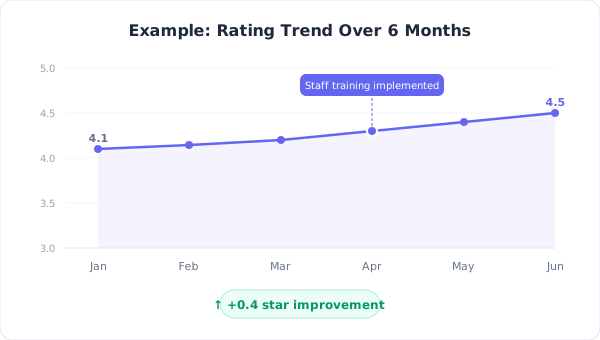
What matters far more is the direction. Are you trending up from 4.1 six months ago? That's genuine improvement. Are you drifting down from 4.5? Something changed and you need to find out what.
How to track this without a tool: At the end of each month, note your average rating on each platform. A simple spreadsheet works — date, platform, rating, number of reviews that month. After three months, you have enough data to see a trend.
What to look for:
- Steady or improving: keep doing what you're doing
- Gradual decline (0.1-0.2 over 3 months): investigate. Something operational has slipped.
- Sudden drop: a specific event caused this. Check recent negative reviews for common threads.
Most consumers filter out a low average before they read a single review, and the Spiegel Research Center found that purchase likelihood peaks between 4.2 and 4.5 stars rather than at a perfect 5. If you're between 3.5 and 4.0, improving by even 0.2 stars can meaningfully affect customer acquisition. Above 4.0, the effect levels off — going from 4.2 to 4.4 matters less than going from 3.6 to 3.8.
Topic frequency is where the real insight lives
Star ratings tell you if there's a problem. Topics tell you what the problem is.
Read through your last 30 reviews and write down every specific thing customers mention. Not "good" or "bad" — the actual topics. Wait times. Staff friendliness. Parking. Food temperature. Price. Cleanliness. Communication.
Now count them. You'll find that 3-4 topics dominate. These are your signal.
An illustrative example: Take a café owner in Manchester who reads through 40 recent Google reviews. Here's what comes up:
- Coffee quality: mentioned in 22 reviews (mostly positive)
- Wait times: mentioned in 14 reviews (mixed — 8 negative, 6 neutral)
- Staff friendliness: mentioned in 11 reviews (almost all positive)
- Seating comfort: mentioned in 7 reviews (mostly negative)
- Prices: mentioned in 5 reviews (split)
The insight isn't that coffee is good (the owner already knew that). It's that wait times appear in 35% of reviews and skew negative. That's an operational problem worth solving. And the seating complaints, though less frequent, were consistently negative — a relatively cheap fix that could eliminate a recurring source of bad reviews.
How often to do this: Monthly is enough. Quarterly is the minimum. Weekly is overkill unless you're getting 20+ reviews per week.
Response rate correlates with rating improvement
This is one of the clearest patterns in review data, and it's backed up by research. Proserpio and Zervas, in a Marketing Science study of hotels on Tripadvisor, found that when a business starts responding to reviews its average rating rises by about 0.12 stars and it receives around 12% more reviews.
The mechanism is straightforward. When potential reviewers see that a business responds, they adjust their behaviour. Mildly dissatisfied customers are less likely to leave a 1-star rage review if the owner clearly engages. Happy customers are more likely to bother leaving a review when they see it'll be appreciated.
Track your own data: Note your response rate each month (responses divided by total reviews, as a percentage) alongside your average rating. After 3-4 months, you'll likely see the correlation.
Don't expect a dramatic jump — the research points to a tenth of a star or so. That might sound small, but on platforms that round to the nearest half star it can be the difference between displaying 4.0 and 4.5, and between being shortlisted and being skipped.
What to check weekly

Spend 5 minutes every Friday looking at:
New review count: How many came in this week? Is that normal for you? A sudden drop might indicate a problem with your review request process. A spike might mean something went viral or a competitor closed.
Any reviews below 3 stars: These need a response. They also need a quick "one-off or pattern?" check. One complaint about parking is an anecdote. Three in two weeks is a pattern.
Response completeness: Did every review get a reply this week? If not, catch up now.
What to check monthly
Give yourself 15-20 minutes at the end of each month:
Rating trend: Calculate your average rating for the month across each platform. Compare to last month and the month before. Three data points show you a direction.
Topic scan: Skim through the month's reviews with a highlighter mindset. What topics keep appearing? Has anything new cropped up? Has a previous problem gone away?
Platform comparison: Are your Google reviews telling a different story than Trustpilot? Google skews toward walk-in customers; Trustpilot toward online purchasers. (Facebook shows a recommendation percentage rather than a star average, so compare it on its own terms.) If one platform is notably worse, it points to a specific part of the customer journey.
What to check quarterly
Once every three months, spend 20 minutes on the big picture:
6-month rating trajectory: Plot your monthly averages. The trend line tells you whether your overall customer experience is improving.
Competitor comparison: Check the ratings of 2-3 direct competitors. If everyone in your category dropped 0.1 stars this quarter, that's market-wide. If only you dropped, that's you. (Reviewdar can track competitors' Google ratings for you on higher plans.)
Operational decisions: If "wait times" has been a top complaint for two consecutive quarters, that's not a review problem — it's a staffing or process problem. Act on it.
Review source effectiveness: Which method generates the most reviews? QR codes on receipts? Follow-up emails? In-person asks? Track what works.
The simplest version that works
If everything above feels like too much, here's the minimum viable analytics routine:
- Every Friday (2 minutes): Count this week's new reviews. Reply to any you missed.
- Every month (10 minutes): Note your average rating on each platform. Read through the month's reviews looking for repeated topics.
- Every quarter (20 minutes): Compare this quarter's numbers to last quarter's. Make one operational change based on what you find.
That's 30 minutes per month. You'll spot problems months earlier than businesses that ignore patterns. You'll have actual data behind decisions instead of gut feeling.
When your review volume grows past what you can easily track manually — usually around 15-20 reviews per month — that's when automated analytics tools start saving you genuine time and catching patterns you'd miss. That's the job Reviewdar does: it reads sentiment and topics across every review, tracks the rating trend per platform and location, and exports a summary report as CSV.
See how Reviewdar turns your reviews into clear, actionable patterns →
Ready to transform your review management?
Join thousands of UK businesses using Reviewdar to manage their online reputation.