
Sentiment Analysis 101: Understanding What Customers Really Mean

Star ratings lie. Not deliberately, but by omission. A four-star review from someone who loved the food but hated the wait tells you something completely different from a four-star review from someone who found the service excellent but the portion sizes disappointing. The star count is identical. The useful information is entirely different.
Sentiment analysis reads between the stars.
What it actually is
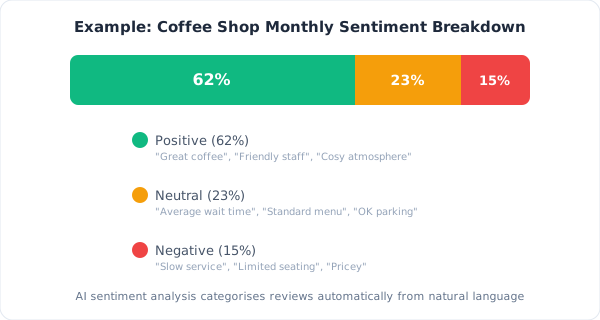
Strip away the academic jargon and sentiment analysis is straightforward: software reads text and works out whether the writer is expressing positive, negative, or neutral feelings. Modern systems go further — they identify which specific topics the sentiment applies to.
"The steak was brilliant but we waited forty minutes for a table" contains two distinct sentiments. Positive about the food. Negative about the wait time. A basic star rating mashes those together into a single number. Sentiment analysis separates them.
The technology behind this uses natural language processing — pattern recognition applied to text. It's not perfect. Sarcasm trips it up sometimes. British understatement can confuse it ("the chips were... fine" might be lukewarm praise or devastating criticism depending on context). But across hundreds or thousands of reviews, the aggregate patterns are reliable even when individual readings have noise.
Why star ratings aren't enough
Consider two restaurants. Both have a 4.1-star average across 500 reviews. By star rating alone, they look equivalent.
Restaurant A's reviews cluster around specific praise for food quality and specific complaints about service speed. Restaurant B gets consistent marks for friendly staff but recurring mentions of high prices. These are fundamentally different businesses with fundamentally different improvement opportunities, masked by an identical number.
A star rating is a blunt summary. It tells you roughly how customers feel overall. It doesn't tell you what drives that feeling, which aspects of your business generate the strongest reactions, or where to focus if you want to improve.
For a business owner making operational decisions — hiring, training, menu changes, pricing — the star rating is nearly useless as actionable data. The text of the reviews is where the useful signal lives. Sentiment analysis extracts that signal at scale.
How topic extraction works
Modern sentiment analysis doesn't just score overall positive or negative. It identifies topics within reviews and scores sentiment for each one.
From a single hotel review: "Beautiful room with a stunning view. Breakfast was disappointing — limited options and cold toast. The spa was relaxing, though the booking process was confusing."
Topic extraction pulls out:
- Room quality: positive
- View: positive
- Breakfast quality: negative
- Breakfast variety: negative
- Spa experience: positive
- Booking process: negative
Now multiply that across 200 reviews. You get a clear picture: rooms are your strength, breakfast needs attention, the spa is well-liked but the booking friction is costing you. That's a prioritised to-do list generated directly from customer feedback.
For a restaurant, the common topics might be food quality, portion size, service speed, staff friendliness, value for money, ambience, and cleanliness. For a trades business, it's punctuality, communication, workmanship quality, tidiness, and pricing transparency. The topics vary by industry but the principle is the same.
Spotting problems before they become crises

This is where sentiment analysis shifts from interesting to genuinely valuable: trend detection.
Imagine you run a dental practice. Your overall rating holds steady at 4.5 stars month after month. Everything looks fine. But sentiment analysis shows that mentions of "wait time" have shifted from 80% positive to 45% positive over the past three months. No single review flagged it as catastrophic. The star rating hasn't budged. But the trend line tells you that something changed — maybe a staffing issue, a scheduling change, or increased demand — and patients are noticing.
Catching that trend at three months lets you fix it. Missing it until it drags your star rating down means you've already lost patients who decided to switch without telling you why.
The same principle applies to positive trends. If sentiment around "value for money" spikes after you adjust pricing or introduce a new package, that's data confirming the change worked. Without sentiment tracking, you'd be guessing based on revenue numbers alone, which lag behind the customer perception shift.
Illustrative examples from UK businesses
Take three illustrative examples — composites of the pattern, not client case studies.
Restaurant scenario. A curry house in Leicester with 800+ reviews. Overall rating: 4.3 stars. Sentiment analysis reveals "portion size" turned negative six months ago — coinciding with a menu revision that cut portions to offset ingredient costs. Stars barely moved because food quality stayed high. The owner hadn't noticed because they watched the number, not the words.
Retail scenario. A boutique in York. Sentiment around "staff knowledge" was consistently the strongest topic — the owner used this to hire specifically for product expertise. Meanwhile, "opening hours" sentiment was negative — customers wanted later Thursday closing. A simple operational change, informed directly by the data.
Trades scenario. An electrician in Glasgow. "Communication" scored lower than "workmanship quality." Customers loved the work but felt left in the dark about scheduling. Fix: automated text updates when en route and a follow-up after the job. Communication sentiment improved within two months.
Neutral sentiment matters too
Positive and negative get the attention, but neutral carries its own message. "The room was adequate." "Food was okay." "Service was standard." That's not praise. It's indifference.
Indifference doesn't generate complaints. It generates silence. Customers who feel neutral don't leave reviews, don't recommend you, and don't come back with the same loyalty.
For your core offering — the food at a restaurant, the results at a salon, the reliability of a trades service — neutral is a warning sign. It means you're forgettable.
Common misunderstandings
"We only have 50 reviews, so it won't help." Below 30-40 reviews, trends are unreliable. But most businesses operating over a year across multiple platforms have enough. The analysis gets more valuable as reviews accumulate.
"Our customers don't write much." "Great service, bit pricey" contains two clear signals. You don't need paragraphs. A star-only review with no text gives the analysis nothing to work with, though — one more reason to ask for a sentence or two.
"We already read all our reviews." Reading and systematically extracting trends are different activities. A human reading 500 reviews remembers the most recent, the most extreme, and the ones confirming existing beliefs. That's anecdotal recall with confirmation bias, not analysis.
Making it practical
Sentiment analysis is useful exactly to the degree that it connects to decisions.
If "cleanliness" drops, that's a specific operational issue. If "value for money" is your weakest topic, that's a pricing conversation. If "staff friendliness" is consistently your strongest signal, protect it — make sure hiring and training reinforce what customers already love.
A simple monthly check — what improved, what declined, what do we do about it — beats any amount of passive data collection. Gut feeling tells you how your business is doing. Sentiment analysis tells you how your customers think it's doing. The gap between those two is where the useful information lives.
Reviewdar runs sentiment and topic analysis across every review it pulls in from your connected platforms and groups the results into insights you can act on. Explore how it works at reviewdar.com/features or see what each plan includes at reviewdar.com/pricing.
Ready to transform your review management?
Join thousands of UK businesses using Reviewdar to manage their online reputation.