
How to Spot (and Report) Fake Reviews on Google, Trustpilot, and Facebook

Fake reviews are a real problem, and if you run a UK business that depends on its online reputation, you've probably already encountered them. A sudden one-star rating from someone who was never your customer. A suspiciously glowing five-star review on a competitor's profile that reads like it was written by a marketing intern. The frustration is justified — these reviews affect your revenue, and the platforms are painfully slow at dealing with them.
Here's how to identify fake reviews, report them on the major platforms, and set realistic expectations about what actually happens next.
How to Spot a Fake Review
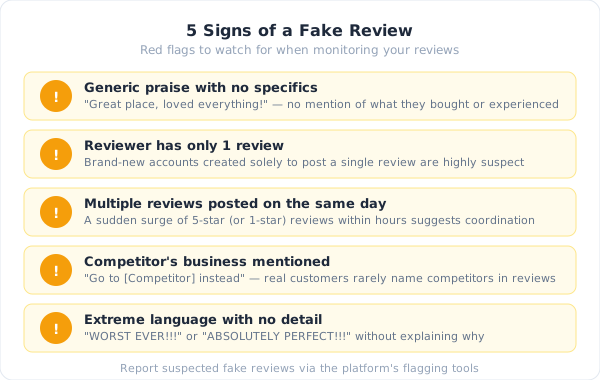
Not every bad review is fake, and not every glowing review is genuine. But there are reliable patterns.
The reviewer has no history
Click on the reviewer's profile. On Google, check how many reviews they've left and when. A profile created last week with a single one-star review on your business is suspicious. On Trustpilot, check if they've reviewed other businesses — an account with one review and no profile details is a red flag. This alone isn't proof, but combined with other signals, it's telling.
The review is vague or generic
Real reviews mention specifics: a dish, a person, a date, a particular problem. Fake reviews tend to be either extremely short ("Terrible service, avoid") or stuffed with generic praise ("Amazing experience, would highly recommend to everyone, best company ever"). If a review could apply to literally any business in your industry, question it.
Multiple reviews arrive in a cluster
Four one-star reviews in 48 hours after months of steady, positive feedback? That's a pattern. Competitor attacks come in bursts. So do bought review campaigns — if a competitor suddenly gains 20 five-star reviews in a week from accounts with minimal history, that's almost certainly purchased. Competitor tracking (Reviewdar's works from competitors' Google reviews, on higher plans) makes spikes like that hard to miss.
The reviewer describes the wrong business
Someone leaves a review mentioning a product you don't sell, a location you don't have, or staff members who don't exist. Sometimes an honest mistake. Sometimes a coordinated attack using templated reviews.
The language feels artificial
Reviews from AI or content farms have a particular flavour: overly formal, no contractions, oddly structured sentences. "The establishment provided an exemplary standard of service" — no one talks like that after getting their boiler fixed.
How to Report Fake Reviews on Google
Step 1: Find the review on your Google Business Profile, click the three-dot menu, select "Report review." Choose the reason (spam, off-topic, conflict of interest).
Step 2: Check progress in Google's Reviews Management Tool (search "manage reported reviews" from your Business Profile). Each report shows as pending, reviewed with no violation found, or escalated.
Step 3: If Google finds no violation, you get one appeal per review through the same tool — up to ten reviews per submission. Have evidence ready: the reviewer's empty profile, the timing pattern. The decision comes by email.
Timeline: Google publishes no timescale. Expect days for the first decision and longer for an appeal.
What actually works: Reviews that reference the wrong business, contain hate speech, or come from obviously fake accounts get removed most often. Reviews that are simply negative and plausibly real almost never get removed.
How to Report Fake Reviews on Trustpilot
Trustpilot takes flagging more seriously than most, partly because reputation is their business model.
Step 1: Log into your Trustpilot Business account, find the review, click "Report." Options include the review not being based on a genuine experience and the review being about a different company.
Step 2: Provide evidence — proof the reviewer never ordered, never contacted you, or describes something that doesn't match your business.
Timeline: 7-10 business days. They'll contact the reviewer and ask for proof of purchase. If the reviewer can't verify, the review gets removed. Trustpilot says flagging and moderation work the same whether or not you pay.
How to Report Fake Reviews on Facebook

Facebook's recommendation system is the weakest of the three. Click the three dots, select "Report Recommendation," choose the reason, and... wait. Facebook provides almost no feedback and rarely communicates outcomes.
Timeline: Unpredictable. Hate speech and obvious spam sometimes get removed. Everything else largely stays. Your best option for a persistent fake Facebook review is to respond publicly and factually.
When Reporting Doesn't Work (Which Is Often)
Here's the uncomfortable truth: platforms remove a minority of reported reviews. Google's automated systems are conservative — they'd rather leave a questionable review up than risk removing a genuine one. Trustpilot is better, but still imperfect. Facebook is largely absent from the conversation.
So what do you do when you can't get a fake review removed?
Respond publicly and factually
Write a calm, professional response. If the reviewer was never your customer, say so clearly: "We don't have any record of this interaction in our system. If you could contact us directly at [email], we'd like to understand what happened." This signals to future readers that this particular review may not be legitimate. Don't accuse the reviewer of lying, even if they obviously are — aggression backfires.
Bury it with volume
One fake one-star review in a sea of 200 genuine reviews is noise. One fake one-star in 12 total reviews is a disaster. The best long-term defence against fake reviews is having enough real ones that any individual review barely moves the needle.
Document the pattern
If you suspect a coordinated competitor attack, document everything: timestamps, reviewer profiles, review content, similarities between reviews. This evidence becomes useful if you escalate further — to the platform or through legal channels.
UK Legal Options
Since 6 April 2025, the Digital Markets, Competition and Consumers Act 2024 has made fake reviews, commissioning them, and offering an incentive for a review without disclosing it banned practices in the UK, replacing the 2008 consumer protection regulations. The CMA can enforce directly, with fines of up to 10% of global turnover, and any business that publishes reviews must take reasonable steps to stop fake ones appearing. Sellers of fake reviews and organised campaigns can be reported to the CMA.
For individual businesses, the practical legal route is a defamation claim — but identifying the reviewer and proving the review is false costs thousands of pounds and takes months. It's rarely worth it for a single review. More viable when you can identify a competitor orchestrating a campaign. Trading Standards can also investigate systematic fake review campaigns, though response times vary by local authority.
Prevention Is Cheaper Than Cure
Building a steady stream of genuine reviews is the most cost-effective defence against fake ones. Automated review request workflows, consistent follow-ups after service delivery, and making the review process simple all help build the volume that makes fake reviews insignificant. Review-request emails and a QR code at the point of service — both of which Reviewdar provides — are the simplest way to build it.
Monitoring your reviews daily means you catch fake reviews early, when reporting is most effective. A review that's been live for six months is harder to contest than one posted yesterday.
Reviewdar pulls your Google, Facebook and Trustpilot reviews into one inbox and lets you know when new ones land (depending on your plan), so you can respond fast and flag fakes before they do damage. See how it works or start your free trial.
Ready to transform your review management?
Join thousands of UK businesses using Reviewdar to manage their online reputation.