
Trustpilot vs Google Reviews: Where Should UK Businesses Focus?
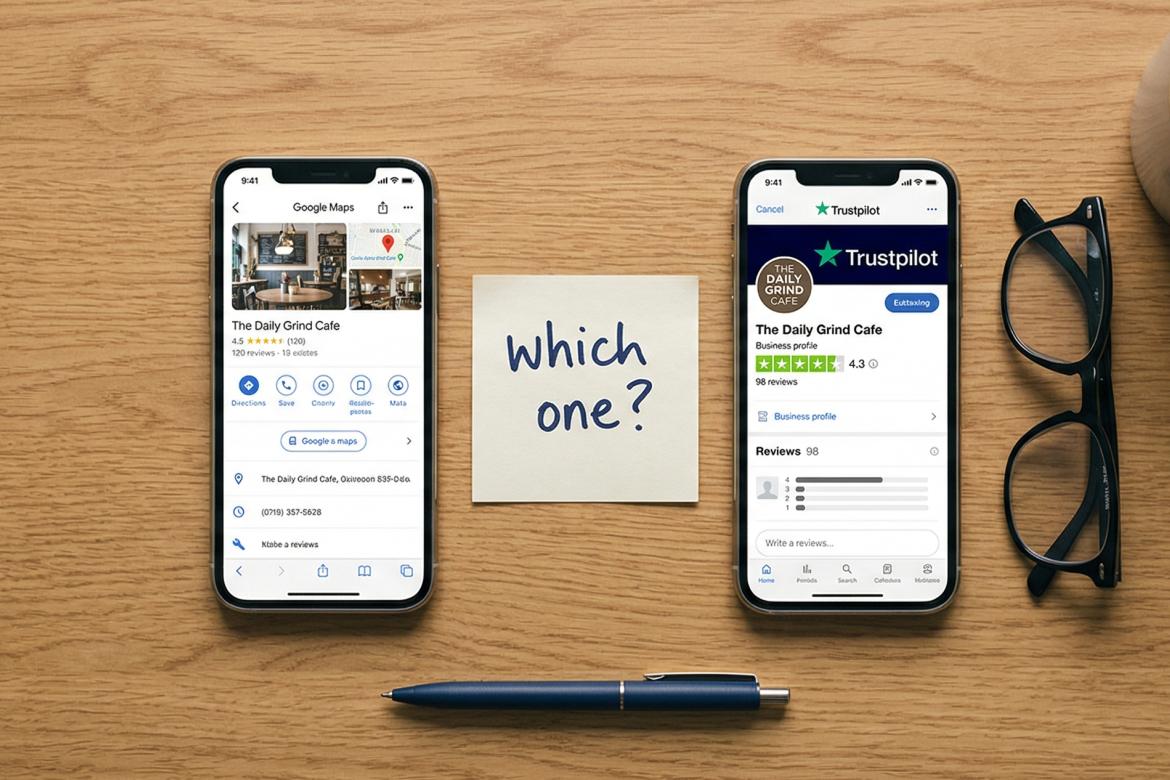
Most UK small businesses don't have the time or energy to be everywhere. You need to pick your battles. And the two platforms that come up again and again are Google Reviews and Trustpilot. They serve different purposes, attract different types of customers, and cost very different amounts of money.
Here's a straight comparison so you can decide where your limited time actually pays off.
Google Reviews Are Free and Inescapable
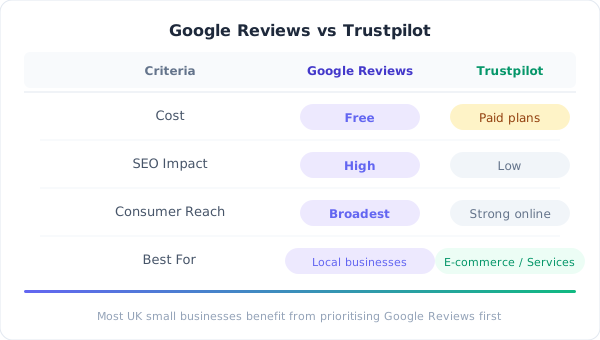
Google Reviews cost nothing. They sit right on your Google Business Profile, which shows up whenever someone searches your name or your service type. You don't opt in — if your business exists, Google already has a listing for it, and people can already leave reviews there.
That makes Google the default. According to BrightLocal's Local Consumer Review Survey 2024, 81% of consumers use Google to read reviews of local businesses. Not some businesses. Not online-only businesses. Local ones: your plumber, your cafe, your accountant.
The review count, star rating, and recency all feed into Google's local search algorithm. So Google Reviews don't just build trust — they directly affect whether people find you in the first place. A business with 60 recent reviews at 4.5 stars will usually sit above a competitor with 8 reviews at 5.0 stars in the local map pack — Whitespark's Local Search Ranking Factors 2023 puts reviews third among map-pack factors, behind the profile itself and your website.
There's no paid tier. No subscription. No paywall between you and your reviews. The only cost is the time it takes to ask customers and reply.
Trustpilot Costs Money, and That Shapes Everything
Trustpilot's free plan lets customers leave reviews, and you can reply to them and send a limited number of invitations, but not much more. The paid plans — a couple of hundred pounds a month per domain at the entry level, on a 12-month contract — unlock automated review invitations, widgets for your website, and analytics.
That price point tells you something about who Trustpilot is really built for. It's aimed at e-commerce companies and larger service businesses who drive traffic through their website, not through local search. If you sell mattresses online, Trustpilot matters a lot. If you run a local barbershop, it probably doesn't.
Trustpilot does carry weight with certain UK consumers — it's where many people look before buying from a brand they've never heard of. That matters, but pay attention to the framing: unfamiliar brand and purchase. This is discovery-stage trust-building for online transactions. It's not the same dynamic as someone searching "boiler repair near me" and picking from the map results.
When Google Reviews Win
For any business that serves a local area — restaurants, tradespeople, salons, dental practices, accountants, gyms — Google Reviews are almost always the priority. Here's why:
Local search visibility. Google Reviews directly impact your ranking in local search results. Trustpilot reviews don't. When someone searches "best Italian restaurant in Leeds" or "emergency plumber Sheffield," your Google profile and its reviews determine whether you appear.
Zero cost. You're already paying for your time. Why add a Trustpilot subscription on top when the platform that matters most for local discovery is free?
Customer expectation. UK consumers looking for local services check Google first. It's reflexive. They open Google Maps or type "[service] near me." Your Trustpilot score doesn't appear in that flow.
Review volume is easier to build. Because every Google user already has an account, the friction to leave a review is minimal. Tap the link, pick your stars, write a line or two, done. Trustpilot requires a separate account, which adds a step that kills conversion rates.
When Trustpilot Wins

Trustpilot earns its keep in specific situations.
E-commerce. If you sell products online and your customers find you through ads, social media, or organic search (not local search), Trustpilot is where they'll check before buying. A strong Trustpilot profile with hundreds of reviews acts as social proof for an audience that can't visit your shop or meet you in person.
Higher-value services sold online. Insurance comparison, financial services, legal services marketed nationally — these benefit from Trustpilot because the customer is making a decision based on trust in a brand they can't physically verify.
Google Ads. Trustpilot reviews can feed into Google Seller Ratings, which display star ratings in your paid search ads. If you spend significantly on Google Ads, this can improve click-through rates. But you need around 100 verified reviews per country within Google's qualifying window, and you need a paid Trustpilot plan to generate that volume consistently.
Competitor pressure. In some industries — energy suppliers, broadband providers, online retailers — customers actively compare Trustpilot scores. If all your competitors have Trustpilot profiles and you don't, the absence itself becomes a signal.
The Industry Breakdown
Here's a rough guide, based on how UK consumers actually behave:
Google is the clear priority for: restaurants, cafes, pubs, hairdressers, barbers, gyms, dental practices, GP surgeries, tradespeople, estate agents, local solicitors, car garages, cleaning services, and any business with a physical location that serves a local area.
Trustpilot is worth the investment for: online retailers, insurance brokers, energy companies, SaaS products, national service providers, and businesses spending heavily on Google Ads.
Both matter for: businesses that operate locally and sell online, like a boutique with an e-commerce store, or a tradesperson who also sells products through their website.
The Time Problem Is Real
Even if both platforms matter for your business, you probably can't maintain both well. Replying to reviews takes time. Generating new reviews takes effort — and it has to be done honestly: since 6 April 2025 the Digital Markets, Competition and Consumers Act 2024 makes fake reviews and undisclosed incentives for reviews banned practices, and both Google and Trustpilot prohibit them in their own rules. Monitoring for fake or malicious reviews requires attention.
If you're a two-person operation, spreading yourself across both platforms means doing neither one properly. A Google profile with 80 reviews and thoughtful responses beats a Google profile with 40 reviews and a Trustpilot profile with 30 reviews where half are unanswered.
BrightLocal found that 88% of consumers are more likely to use a business that responds to all of its reviews. Response matters more than platform coverage.
What About Facebook, Yelp, and the Rest?
Facebook recommendations matter for certain local businesses (particularly hospitality and events), but they've become less prominent as Facebook has deprioritised them in its interface. Yelp is a minor player in the UK compared to the US. Tripadvisor is essential for restaurants and hotels but irrelevant for most other businesses.
None of them replace Google for local search, and none of them replace Trustpilot for e-commerce trust signals.
The Bottom Line
If you're a local UK business with a physical presence or a service area, start with Google. Get your Google Business Profile sorted, build your review volume, respond to every review, and keep the momentum going. That alone will do more for your visibility and conversion than anything else.
If you sell online, sell nationally, or spend real money on Google Ads, Trustpilot is worth evaluating — but run the numbers on the subscription cost against the actual revenue impact before committing.
Either way, trying to do everything at once is a trap. Pick one, do it well, then expand.
Reviewdar pulls reviews from Google, Facebook and Trustpilot into one dashboard, with read-only Tripadvisor and Yelp imports rolling out on higher plans, and drafts replies for you to edit — so when you are ready to manage multiple platforms, you don't need five browser tabs open. See how it works or check pricing.
Ready to transform your review management?
Join thousands of UK businesses using Reviewdar to manage their online reputation.