
The UK SME's Guide to Managing Reviews Across Facebook, Google, and Trustpilot

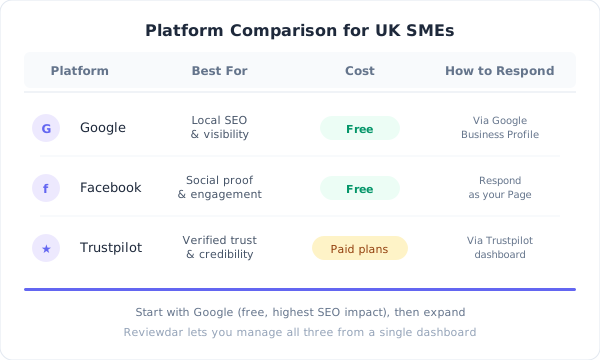
Google, Facebook, and Trustpilot each play a different role for your business. Treating them the same — same responses, same attention, same strategy — is why most UK small businesses waste time on review management without seeing results.
Here's how each platform actually works, what matters on each one, and how to cover all three in about 15 minutes a day.
Google is your shop window
When someone searches "plumber near me" or "best Thai restaurant Chelmsford," Google reviews are the first thing they see. Your star rating shows up before your website does.
Google reviews directly affect your local search ranking. Whitespark's Local Search Ranking Factors 2023 survey put reviews as the third-largest factor in local pack rankings, behind only your Google Business Profile itself and your website's on-page signals. For UK SMEs, this means Google should be your primary review platform. Not your only one — but the one you never neglect.
What matters on Google:
- Response speed. Aim for 24 hours. Google says responding to reviews can help your business stand out; response rate is not a confirmed ranking factor, but readers notice.
- Keywords in responses. When a customer mentions "wedding catering in Bristol" and you reference it naturally in your reply, it reinforces what you do for everyone skimming the page — just don't stuff it.
- Star volume. You need a steady flow, not a burst of 50 reviews followed by silence.
Common Google mistakes:
- Copy-pasting the same response to every review. Customers notice, and it reads as a template.
- Ignoring reviews under 3 stars. Those are the ones potential customers read first.
- Not using your actual business name in responses. It reads as more personal and reminds readers who is replying.
Facebook is your community
Facebook reviews (now called Recommendations) work differently. They're binary — people either recommend you or they don't. There's no star system, though older reviews still show ratings.
The real value of Facebook isn't the reviews themselves. It's that reviews appear in a social context. When someone recommends your business, their friends see it. That word-of-mouth effect matters more than the recommendation count.
What matters on Facebook:
- Tone. Facebook is casual. Your responses should sound like a human, not a customer service bot.
- Speed of community management. People expect fast replies on Facebook — most consumers expect a business to reply on social media within 24 hours.
- Engaging with the positive. Unlike Google, where you're performing for strangers, Facebook responses are partly about deepening relationships with existing customers.
Common Facebook mistakes:
- Being too formal. "Dear valued customer, thank you for your feedback" reads badly on Facebook. Try "Thanks, Sarah — really glad you enjoyed the tasting menu!"
- Ignoring negative recommendations. They're visible to the poster's entire network. A thoughtful public response limits the damage.
- Forgetting that comments on posts function as informal reviews too. Monitor those.
Trustpilot is your credibility badge
For UK consumers, Trustpilot carries specific weight. It's the review platform people check when they're already interested but haven't committed. It's especially strong in services, e-commerce, and any business where customers pay before receiving.
Trustpilot's verified review labels mean readers give these reviews more weight, and the UK is one of Trustpilot's largest markets — for many UK shoppers it is the second check after Google.
What matters on Trustpilot:
- Verification. Trustpilot distinguishes between verified and unverified reviews. Encourage verified ones by using Trustpilot's invitation tools.
- Your company reply rate. Trustpilot shows this publicly. A 90%+ reply rate signals that you care.
- TrustScore maintenance. Your score is weighted toward recent reviews, so consistency matters more than a handful of old 5-stars.
Common Trustpilot mistakes:
- Not claiming your profile. An unclaimed Trustpilot page with a few bad reviews is worse than no Trustpilot presence at all.
- Not inviting reviews. Trustpilot's invitation tools are how you build volume; a profile with a handful of unsolicited reviews rarely reflects your real customer base.
- Responding to negative reviews defensively. Trustpilot's audience is sceptical by nature. They read the negative reviews carefully. Your response is your audition.
The 15-minute daily routine

You don't need an hour a day for this. You need 15 focused minutes with a system.
Morning check (5 minutes): Open all three platforms. Google Business Profile, Facebook Page, Trustpilot dashboard. Scan for new reviews since yesterday. Flag any negative ones that need a careful response.
Quick responses (7 minutes): Reply to positive reviews first — they're fast. A personalised two-sentence reply works. For the flagged negative reviews, draft a response but don't post it yet. Let it sit for a few hours if emotions are involved.
Weekly patterns (3 minutes): Once a week, replace this slot with a quick trend check. Are ratings trending up or down? Any recurring complaints? One staff member getting mentioned repeatedly (good or bad)?
The batch approach: Monday through Thursday, do the 15-minute routine. Friday, take 20 minutes for your weekly review. Saturday and Sunday, check only if you get notification of a 1-star review. That's under 90 minutes a week total.
Response etiquette differs by platform
The same negative review needs three different responses depending on where it appears.
On Google, be professional and solution-oriented. Mention your business name. Offer to resolve things offline: "Hi James, I'm sorry your experience at [Business Name] didn't meet expectations. Please reach out to us at [email] so we can put this right."
On Facebook, be warmer and more conversational. The audience expects personality: "James, that's not the experience we want anyone to have. I've dropped you a DM — let's sort this out."
On Trustpilot, be thorough. Trustpilot readers are evaluating your professionalism. Acknowledge the issue, explain what you've done about it, and invite follow-up: "Thank you for sharing this, James. We've looked into what happened and [specific action]. We'd welcome the chance to discuss further — please contact [name] directly at [email]."
Same complaint. Three tones. Each appropriate to where it appears.
On all three, a review that breaks the platform's rules — fake, abusive, or about another business — is flagged through that platform's reporting tool rather than argued with. And however you ask for reviews, ask everyone and offer nothing for it: since 6 April 2025 the Digital Markets, Competition and Consumers Act 2024 has made fake reviews and undisclosed incentivised reviews banned practices, enforced directly by the CMA with fines of up to 10% of global turnover, and Google's own policy bans incentives and review gating too.
Stop trying to be everywhere at once
If you're just starting out, pick one platform and get it right. For most UK SMEs, that's Google. It has the biggest impact on whether new customers find you.
Add Facebook if your business relies on community and repeat customers — restaurants, salons, local services. Add Trustpilot if you're in a category where pre-purchase trust matters — trades, professional services, e-commerce.
Managing three platforms manually gets old fast. Once you're active on two or more, a tool that pulls all your reviews into one place saves real time — and makes sure nothing slips through the cracks. Reviewdar does that for Google, Facebook and Trustpilot, drafts replies for you to edit, and sends review-request emails and printable QR codes so you can ask every customer the same way.
See how Reviewdar brings Google, Facebook, and Trustpilot reviews into one dashboard →
Ready to transform your review management?
Join thousands of UK businesses using Reviewdar to manage their online reputation.