
Why 5 Stars Isn't Enough: What Your Reviews Are Really Telling You
You've hit five stars. Customers love you. Job done, right?
Not quite.
A perfect star rating is a nice thing to have, but it tells you almost nothing about why people love you — or what's quietly going wrong underneath the surface. And if you're running a small business in the UK, understanding the why is where the real competitive advantage lives.
The Problem with Star Ratings
Star ratings are blunt instruments. They compress an entire customer experience into a single number. A four-star review from someone who had a brilliant meal but waited 40 minutes for a table looks identical to a four-star review from someone who found the food average but loved the atmosphere.
Both are "four stars." Both mean completely different things for your business.
Here's what star ratings can't tell you:
- What you're doing well — and should double down on
- What's frustrating people — even when they're still giving you good scores
- Where competitors are beating you — in ways customers notice but don't always articulate
- Which staff, locations, or services are driving satisfaction — and which are dragging it down
If you're only looking at your average rating, you're flying blind with a compass that only points to "generally fine."
What Lives Inside the Words
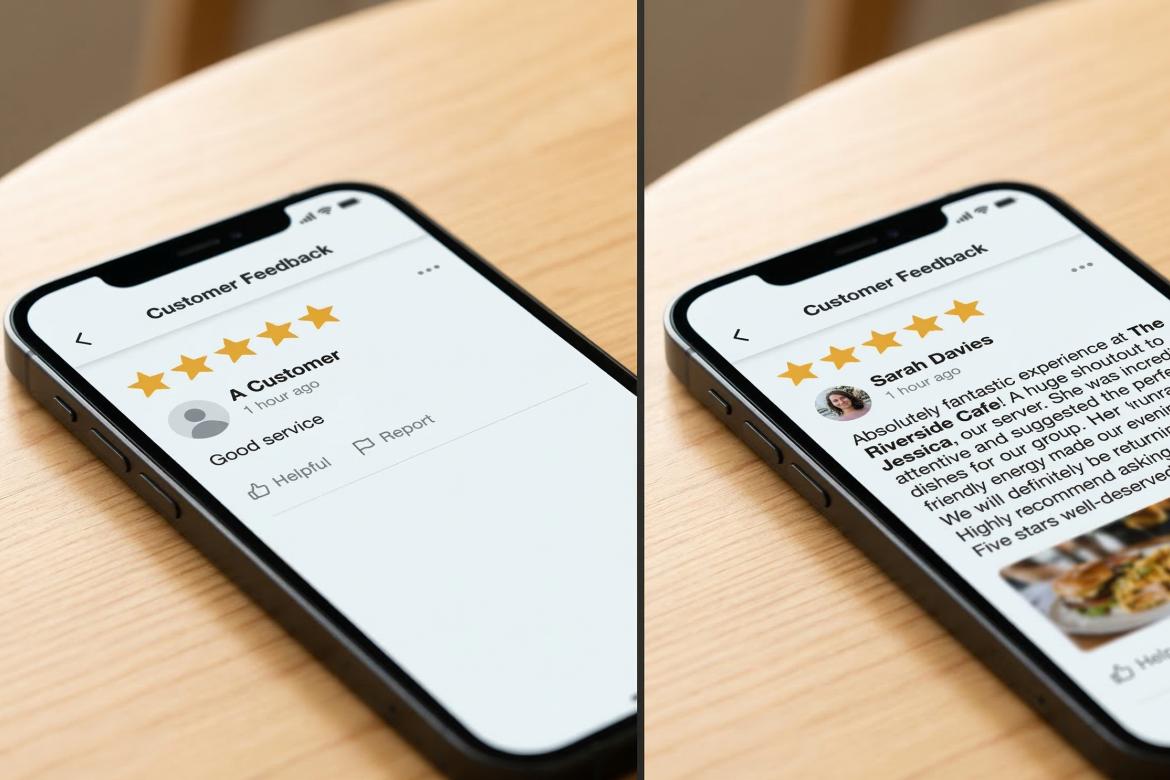
The real intelligence is in the review text. And most UK small businesses never systematically read it.
Think about the last ten reviews your business received. Buried in those paragraphs are specific, actionable signals:
Repeated praise patterns — "always friendly," "great communication," "really quick" — tell you what your brand actually means to people. Not what you think it means. What it actually means. That's gold for marketing, hiring, and training.
Soft complaints — "only reason it's not five stars is the parking" or "food was great but the wait was a bit long" — these are the friction points that don't show up in your star average but absolutely show up in whether someone comes back.
Competitor mentions — "better than [X]" or "switched from [Y]" — these tell you exactly where you're winning in the market and why. No amount of competitor research gives you this kind of direct signal.
Trend shifts — when "friendly staff" stops appearing and "a bit rushed" starts, something has changed operationally. If you're not tracking the language over time, you'll only notice when the star rating finally drops — and by then, you've already lost customers.
The Five-Star Trap
Here's a counterintuitive truth: businesses with nothing but five-star reviews can actually face more risk than those with a healthy mix.
Why?
-
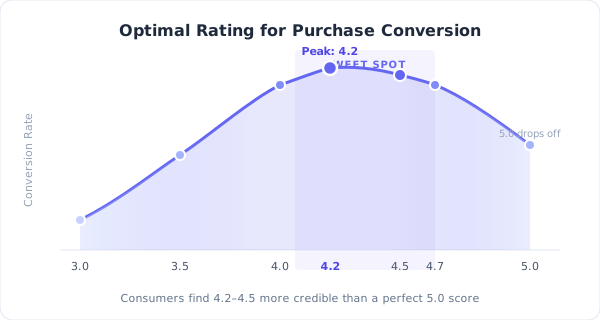
Consumers are suspicious of perfection. Northwestern University's Spiegel Research Center found that purchase likelihood peaks between 4.2 and 4.5 stars and falls away as a rating approaches a flat 5.0. A perfect score looks curated, not credible.
-
You lose the feedback loop. If every review is five stars with "great service!" you have no signal to improve. You're optimising for a number instead of learning from your customers.
-
You become complacent. A perfect rating creates a false sense of security. The business that's reading every three-star review, understanding the complaint, and fixing the root cause is the one that's actually getting better.
What to Do Instead

1. Read the words, not just the stars
This sounds obvious, but most business owners check their star rating and move on. Carve out time — even 15 minutes a week — to actually read recent reviews. Look for patterns, not individual complaints.
2. Track themes over time
Are customers mentioning "value for money" more or less than three months ago? Is "friendly" trending up while "clean" is trending down? This is where review analytics becomes genuinely useful — not as a dashboard to admire, but as an early warning system. Reviewdar's sentiment and topic insights do this across every review it pulls in, so the shift shows up before the star average moves.
3. Respond to every review — especially the good ones
Most businesses only respond to negative reviews, which creates a weird dynamic where the only time customers hear from you is when something went wrong. Responding to positive reviews reinforces what's working and shows future customers that you're engaged.
A good response to a positive review:
- Thanks them specifically (not generically)
- References something they mentioned
- Takes 30 seconds to write
A bad response to a positive review:
- "Thanks for the 5 stars!" (generic, soulless)
- No response at all
4. Use negative reviews as operational data
A one-star review stings. But it's also the most honest feedback you'll ever get — more honest than any survey, because the customer chose to write it unprompted.
When you get a negative review:
- Is this a one-off or part of a pattern?
- Does it point to a specific person, process, or location?
- Can you fix the root cause, not just apologise?
5. Look at review velocity, not just rating
How often are you getting reviews? A business with a 4.8 rating from 200 reviews last year is in a very different position to one with a 4.8 from 15 reviews three years ago. Recency and volume matter enormously for both consumer trust and search visibility: Whitespark's Local Search Ranking Factors 2023 survey put review signals as the third-largest factor in local pack rankings, behind only the Google Business Profile itself and on-page signals.
The Bottom Line
Stars are the headline. Words are the story.
If you're running a small business and you're only tracking your average rating, you're leaving the most valuable part of customer feedback on the table. The businesses that win aren't the ones with the most stars — they're the ones who understand what their reviews are actually saying and act on it.
Reviewdar brings your Google, Facebook and Trustpilot reviews into one place, with sentiment and topic insights that go beyond star ratings. See plans →
Ready to transform your review management?
Join thousands of UK businesses using Reviewdar to manage their online reputation.