
The UK Small Business Guide to Google Business Profile Reviews
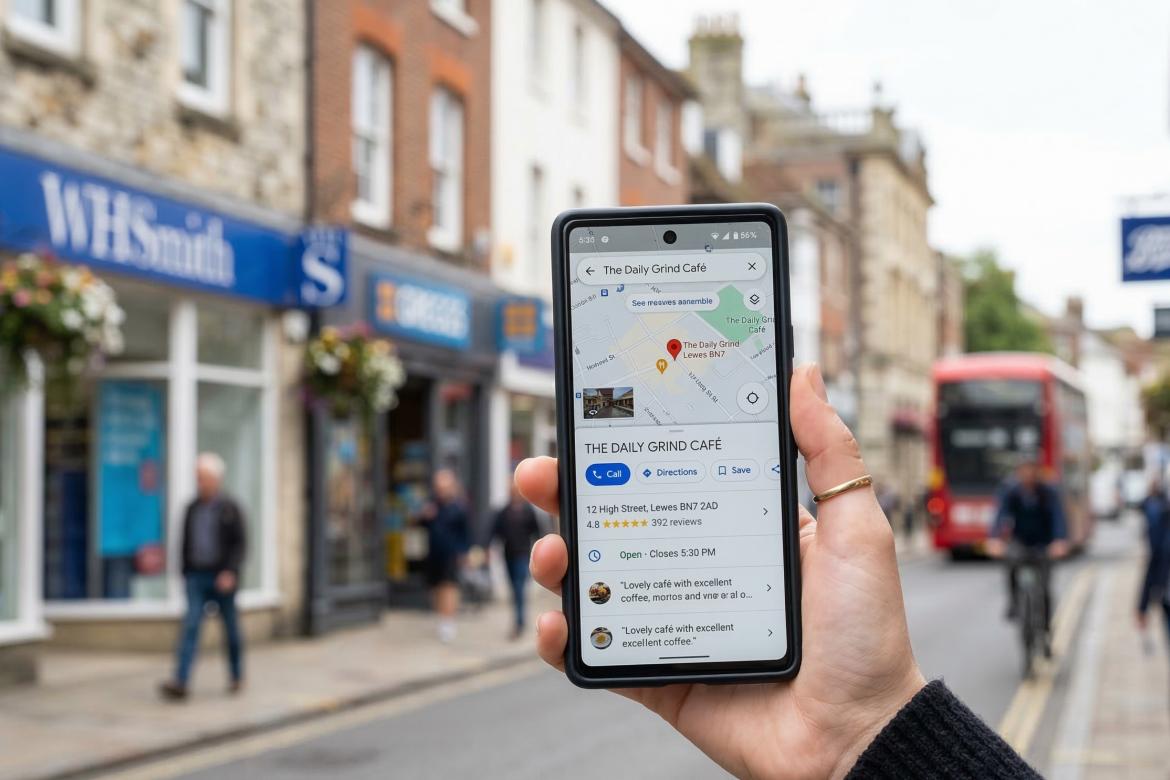
If you run a UK small business with a physical location or a defined service area, your Google Business Profile is probably the single most important piece of online real estate you own. More important than your website. More important than your social media.
Why? Because when someone searches for what you do in your area, Google decides whether to show you — and your reviews are a massive part of that decision.
Here's what you need to know.
Why Google Reviews Matter More Than You Think
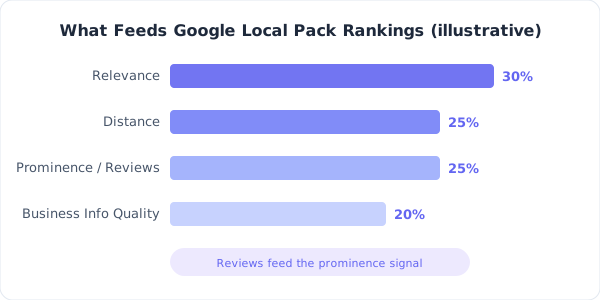
They affect whether you show up at all
Google's local search algorithm uses three main signals: relevance, distance, and prominence. Reviews are a core component of prominence: Google's own guidance says review count and review score factor into local ranking, and that high-quality, positive reviews can improve your visibility. Whitespark's Local Search Ranking Factors 2023 put reviews third among local pack factors, behind the Business Profile itself and on-page signals.
This isn't vague SEO theory — it's directly observable. Search for "[your service] near me" and look at the local pack (the map with three businesses). The businesses showing up almost always have more reviews, higher ratings, and more recent review activity than those that don't.
They're the first thing customers see
Before someone clicks through to your website, they see your star rating and review count on Google. That's your first impression. A business with 4.6 stars from 89 reviews will get more clicks than one with 4.9 stars from 4 reviews. Volume and recency build credibility, and a perfect score isn't the goal anyway: the Spiegel Research Center found purchase likelihood peaks between 4.2 and 4.5 stars.
They influence conversion directly
BrightLocal's Local Consumer Review Survey 2024 found that 81% of consumers use Google to read reviews of local businesses. For many service businesses — restaurants, tradespeople, salons, accountants — Google Reviews are the primary decision factor after price and location.
How to Get More Google Reviews (Without Being Annoying)
Ask at the right moment
The best time to ask for a review is immediately after a positive interaction. Not a week later. Not in a follow-up email that arrives when the customer has forgotten about you. Right then.
For service businesses, that's when the job is done and the customer is happy. For hospitality, it's at the point of payment or checkout. For professional services, it's right after delivering a result.
Make it stupidly easy
Every extra step between "yes, I'll leave a review" and actually leaving one loses you a chunk of your potential reviewers. Google provides a direct review link for your business — use it.
To get your direct review link:
- Search for your business on Google
- Click "Ask for reviews" in your Business Profile dashboard
- Copy the link
Send this link directly. Don't send people to "Google Maps" and expect them to find you, navigate to the review section, and figure it out. One tap, one link.
Use multiple channels
- In-person: A simple card with a QR code at the till or on the invoice
- Email: A follow-up email with a direct review link (send within 24 hours of service)
- SMS: If you have permission, a text with the link converts very well
- Receipts and invoices: Add the QR code or link
Reviewdar handles the email and QR side for Google reviews: it sends the review-request emails (each with an unsubscribe link) and reminders, prints the QR codes, and lands every new Google review in one inbox with an AI-drafted reply for you to edit before posting.
Don't incentivise
This is important: offering rewards for reviews violates Google's policies. Don't offer discounts, free products, or anything else in exchange for a review. Google can and does remove incentivised reviews and can penalise your listing.
It's no longer just Google's rule, either. Under the Digital Markets, Competition and Consumers Act 2024, offering an incentive for a review without disclosing it has been a banned practice in the UK since 6 April 2025, and the CMA can enforce directly with fines of up to 10% of global turnover.
You can remind people. You can make it easy. You just can't pay for it.
Don't cherry-pick
Don't only ask happy customers for reviews. Google calls this review gating and bans it outright, and that includes the "rate us first" forms that only send the five-star crowd on to Google. Beyond the policy, it creates a brittle reputation that collapses when someone unhappy eventually leaves one. A business with genuine reviews — including some critical ones — is more resilient and more trusted.
Managing Your Google Reviews
Respond to everything
Every review deserves a response. Yes, even the ones that just say "Great, thanks." Responding shows engagement: Google's own guidance lists it among the things that can help your profile, and BrightLocal found 88% of consumers would use a business that replies to all of its reviews.
For positive reviews: Thank them specifically, reference something from their review, keep it brief and warm.
For negative reviews: Acknowledge, empathise, address the specific issue, and take it offline. (See our full guide on responding to negative reviews.)
For fake or spam reviews: Flag them through Google Business Profile. Don't respond publicly with "this is fake" — it looks bad even if you're right. Flag, report, and if it's clearly fraudulent, Google will usually remove it, though it can take a while. (See our guide to spotting and reporting fake reviews.)
Monitor regularly
Check your reviews at least weekly. Ideally, set up notifications so you know the moment a new review arrives. The faster you respond — especially to negative reviews — the better the outcome.
If you're managing multiple locations, this becomes operationally challenging fast. That's where centralised review management tools become genuinely useful rather than nice-to-have.
Track your review velocity
"Review velocity" is how many reviews you're getting per week or month. This matters for two reasons:
- Search visibility — a steady, consistent flow of reviews keeps your profile looking active to Google in a way a burst of reviews from two years ago can't
- Consumer trust — customers check the dates on reviews. If your most recent review is from six months ago, that raises questions
What counts as healthy depends on your customer volume: a dentist and a takeaway will never match. The test is consistency. If your reviews arrive in bursts with long gaps between them, your review-generation process needs attention.
Common Mistakes
Ignoring your Google Business Profile entirely
Surprisingly common. Many UK businesses have a Google Business Profile they've never claimed or updated. If you haven't claimed yours, do it today. It's free, it takes 10 minutes, and it's the difference between controlling your online presence and leaving it to chance.
Obsessing over the star rating
Your average rating matters, but it's one number. Review count, recency, response rate, and the actual content of your reviews matter just as much for consumer trust, and count and recency carry weight in search too.
Responding only to negative reviews
This creates a pattern where your only public voice is apologetic. Balance it by responding to positive reviews too. It makes your brand feel warmer and more engaged.
Buying reviews
Just don't. Google's detection is improving constantly, and the consequences — review removal, ranking penalties, potential listing suspension — aren't worth the short-term boost. Since 6 April 2025, writing or commissioning fake reviews has also been a banned practice under the Digital Markets, Competition and Consumers Act 2024, so the CMA can come after you as well as Google. Build it honestly.
Quick Wins You Can Do This Week
- Claim your Google Business Profile if you haven't already
- Get your direct review link and save it somewhere accessible
- Respond to your last 5 unanswered reviews — positive and negative
- Set up a simple ask process — even just a printed card with a QR code
- Check your business information — hours, phone number, address, photos. Accuracy builds trust.
The Bottom Line
Google Business Profile reviews aren't a vanity metric or a marketing nice-to-have. For UK small businesses, they're a core part of how customers find you, evaluate you, and decide whether to choose you.
The businesses that thrive aren't necessarily the ones with the highest ratings. They're the ones with consistent review flow, thoughtful responses, and a genuine willingness to listen to what customers are saying.
Reviewdar pulls your Google, Facebook, and Trustpilot reviews into one dashboard — so you can respond faster, spot trends earlier, and grow your review volume with less effort. Get started free →
Ready to transform your review management?
Join thousands of UK businesses using Reviewdar to manage their online reputation.